The great challenge of domestic humanoid robots

The great challenge of domestic humanoid robots


Souce


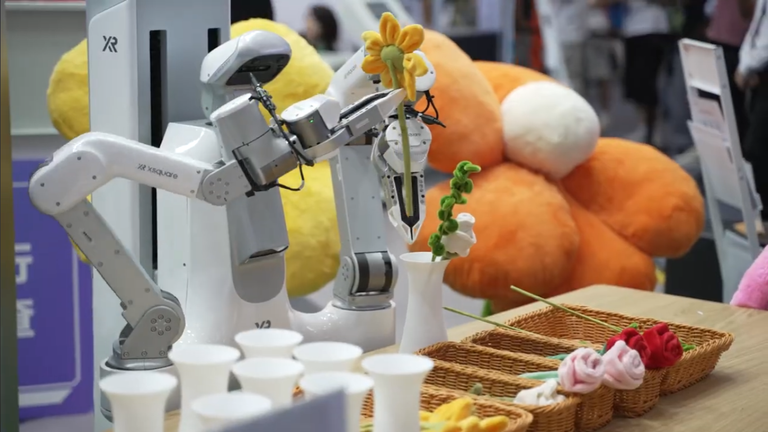
After running, dancing, and performing increasingly impressive demonstrations, Chinese humanoid robots are beginning to tackle a seemingly much simpler challenge: taking care of a home. Robotics companies in China are placing their machines in real domestic environments to learn tasks such as picking up objects, organizing clothes, cleaning surfaces, and even arranging flowers.


One of the companies involved in this movement is X Square Robot, a Chinese startup backed by investors such as Xiaomi and Alibaba. During a demonstration in Beijing, its robots performed various household tasks, but the company's goal goes beyond showcasing pre-programmed skills; X Square has begun deploying its robots in actual homes.


In partnership with the Chinese service platform 58.com, the company created a service where robots work alongside human cleaning professionals in Shenzhen residences. The robots have already entered more than 100 homes as part of this program. During operations, they can pick up scattered items, tidy surfaces, and perform other tasks while the human professional handles the more complex aspects of the cleaning; however, there is a significant technical reason for placing these machines in homes: houses are extremely challenging environments for robots. In a factory, objects usually appear in predictable positions, and machines can repeat movements thousands of times.


Inside a home, practically everything is subject to change: a chair might be moved, a garment could be folded or crumpled, and various objects might appear on a table. Furthermore, every household has a completely different layout. Even seemingly simple tasks—such as folding a piece of clothing—require the robot to identify a deformable object, determine how to grasp it, and adjust its movements while manipulating the fabric.


According to Qian Wang, founder and CEO of X Square Robot, while humanoid hardware has advanced rapidly, developing artificial intelligence capable of handling such variability remains a major challenge. To address this, the company developed an AI model called WALL-B. The system is being trained using data collected from over 100 households, exposing the robots to the kind of cluttered, unpredictable environments that would be difficult to fully replicate in a laboratory setting.


This strategy allows each new home to serve as a data source for refining the models, though the results are still far from replacing a human. In home trials, the robots remain slow and can make mistakes during relatively simple tasks. For instance, in a Beijing home, an X Square robot took about an hour just to fold a few garments and organize some shoes. China is now expanding these experiments, and other companies are also having robots train in ordinary homes.


Sorry for my Ingles, it's not my main language. The images were taken from the sources used or were created with artificial intelligence


Posted Using INLEO


0
0
0.000
1 comments
avatar

Thanks for your contribution to the STEMsocial community. Feel free to join us on discord to get to know the rest of us!

Please consider delegating to the @stemsocial account (85% of the curation rewards are returned).

Consider setting @stemsocial as a beneficiary of this post's rewards if you would like to support the community and contribute to its mission of promoting science and education on Hive. 
 

0
0
0.000