For this contest, I selected a stone that isn't visually appealing or as ancient as the dinosaurs. However, can you imagine touching a piece of stone that was probably used in a Roman house? Let me tell you how this little piece of brick ended up in my hand! Enjoy this experience because you will travel with me back more than 1,500 years!🚙📸
Para este concurso seleccioné una piedra no tan atractiva visualmente ni tan antigua como los dinosaurios. Sin embargo, ¿te imaginas poder tocar un pedazo de piedra que probablemente fue utilizado en alguna casa romana? ¡Ya te cuento cómo acabó este pequeño pedazo de ladrillo en mi mano! ¡Disfruta de esta experiencia porque viajarás conmigo más de 1500 años!🏞️🗺️

 Coordinates:39.370119, -7.385868🌏🧭 / Coordinadas: 39.370119, -7.385868📍🌏

Today's visit was quick and touristy, but I took advantage of the great opportunity to create something original for the contest! We know that bricks aren't natural; they're a building material created from a mixture of clay, sand, and water! But I think they have more uses than a simple rock, hehe.🚩📍
La visita de hoy fue rapida y turistica, sin embargo aprovecha la gran oportunidad para crear algo original para el concurso! sabemos que los ladrillos no son naturales, son un material de construccion que se crea con la mezcla de arcilla, arena y agua! pero me parece que tiene mas utilidad que una simple roca jeje,📸🚙

Que historia cuenta?🌏🧭 / What story does it tell?📍🌏


¡Totalmente de acuerdo! Ese enfoque disruptivo es justamente lo que hace que una propuesta destaque en cualquier competencia. Al transformar un objeto arqueológico cotidiano en el centro de un debate geológico, logras que el público y el jurado miren el material con otros ojos. La historia de la humanidad está profundamente ligada a la transformación de la Tierra, y tu "roca artificial" es el puente perfecto entre ambas disciplinas.📍🗺️
I want to clarify something important: the contest says to find a rock in nature. A brick isn't a rock, since it's not formed by a natural process, so I'll take responsibility if the judges deduct a few points, haha. But hey, in the end, this is for fun and learning too! And I know this is a piece of brick because I'm at an archaeological site. The question is, how do you know if what you have in your hand actually corresponds to your rock? Uh, geology is difficult, haha! Every rock, stone, or building material tells a story! With them and carbon-14 dating, you can estimate the age of what's in the ground.🏞️📸


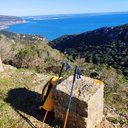
If you look closely, the first stone could have been presented as any other rock, but it actually corresponds to a piece from that pile of bricks which, as you can see, doesn't have the normal characteristics and coloring of a modern brick. Although it may seem crazy, they were manufactured in the 1st century AD, in a city called Ammaia. I want to emphasize that I left the rock there; I didn't take it, as that would be a crime! They were widely used to build frames and chimneys, and they adapted well to different types of structures. This is one of the most pristine cities discovered in Europe; practically no civilization ever built on top of it, unlike many others.🚩📍
Si te fijas, la primera piedra pude haberla presentado como cualquier otra roca, pero en realidad corresponde a un pedazo de ese montón de ladrillos que, como puedes ver, no tienen las características normales ni la coloración de un ladrillo moderno. Aunque te parezca una locura, fueron fabricados en el siglo I d. C., en una ciudad llamada Ammaia. ¡Quiero recalcar que dejé la roca allí y no la tomé, ya que eso sería un delito! Fueron muy utilizados para construir marcos y chimeneas, y se adecuaban bien a diferentes tipos de estructuras. Esta es una de las ciudades más vírgenes descubiertas en Europa; prácticamente ninguna civilización construyó encima de ella, a diferencia de muchas otras.🏰🏞️


There are some records indicating that the city already existed when Augustus was in power, so we can say it was built in the 1st century BC, placing it in the Alentejo region of Portugal, a rather hot area. In total, 25 hectares of construction were discovered! The city was so important that when Lusitania existed, it held administrative power, although the city was mostly famous for its trade route.📸🚩
Hay algunos registros que indican que la ciudad ya existía cuando Augusto estaba en el poder; por lo tanto, podemos decir que fue construida en el siglo I a. C., situándola en el Alentejo de Portugal, una zona bastante calurosa. En total, ¡se descubrieron 25 hectáreas de construcción! La ciudad fue tan importante que, cuando existió Lusitania, ¡esta ciudad ostentaba el poder administrativo, a pesar de que fue más famosa por su ruta comercial!🌏💎
 a Roman shoe print on a stone🌏🧭 / una huella de calzado romano en una piedra📍🌏
The rocks are interesting because they tell a story, as I mentioned in the previous text. In this case, this one has an authentic footprint from a Roman who lived in the city. That's why I emphasize that the brick I'm holding in my hand was surely used by a Roman 1,500 years ago.📍🗺️
Las rocas son interesantes porque cuentan una historia, así como lo mencionaba en el texto anterior. En este caso, esta tiene una auténtica huella de una pisada de algún romano que vivió en la ciudad; por eso hago énfasis en que seguramente el ladrillo que sostengo en mi mano fue usado por algún romano hace 1500 años.📸🚩


Use of stone in the city🌏🧭 / Uso de la piedra en la ciudad📍🌏


🚩 The bricks were used to create the "forum" theatre in the 1st century
🚩 The bricks were used to create the areas of the baths.
🚩 The bricks were used to make the south and north gates
🚩 An amphitheater over 60 meters long was built
What would the Romans be without bricks?🌏🧭 / ¿Qué sería de los romanos sin los ladrillos?📍🌏


🚩 Just to build the Baths of Caracalla, 90 million bricks were used.
🚩 The Colosseum in Rome: 40 million bricks
🚩 The Baths of Diocletian: 100 million bricks
🚩 Trajan's Market: 20 million bricks
If we extrapolate the numbers, we can say that the Romans used hundreds of millions of bricks a year, giving us a reference point that without bricks, Rome was nothing...
Si extrapolamos los números, podemos decir que los romanos utilizaron cientos de millones de ladrillos al año, lo que nos da una referencia de que sin los ladrillos Roma no era nada...
https://es.wikipedia.org/wiki/Arquitectura_de_la_antigua_Roma

You can check out this post and your own profile on the map. Be part of the Worldmappin Community and join our Discord Channel to get in touch with other travelers, ask questions or just be updated on our latest features.
Sin duda presentas una candiata muy disruptiva... un ladrillo.. con la huella de Roma.
Un abrazo muy grande, @biologistbrito!!
!CURATE BY
@quiubi
image.png
Thank you for your contribution to the community🌍🐏
Remember to delegate to us or join the curation trail to participate in the weekly hbd prizes🥇🏅
Interesting discovery. It's fascinating how, after thousands of years, it's the stones and pieces of material that remain the only witnesses of the past.
¡Enhorabuena!
✅ Has hecho un buen trabajo, por lo cual tu publicación ha sido valorada y ha recibido el apoyo de parte de CHESS BROTHERS ♔ 💪
♟ Te invitamos a usar nuestra etiqueta #chessbrothers y a que aprendas más sobre nosotros.
♟♟ También puedes contactarnos en nuestro servidor de Discord y promocionar allí tus publicaciones.
♟♟♟ Considera unirte a nuestro trail de curación para que trabajemos en equipo y recibas recompensas automáticamente.
♞♟ Echa un vistazo a nuestra cuenta @chessbrotherspro para que te informes sobre el proceso de curación llevado a diario por nuestro equipo.
🥇 Si quieres obtener ganancias con tu delegacion de HP y apoyar a nuestro proyecto, te invitamos a unirte al plan Master Investor. Aquí puedes aprender cómo hacerlo.
Cordialmente
El equipo de CHESS BROTHERS
¿Cómo estás, querido amigo @biologistbrito? Buen día.
Como siempre, haces un trabajo destacado y profesional. Muy interesante toda la información que compartes sobre el ladrillo. y su uso. Es increíble cuántos ladrillos han necesitado los romanos para sus construcciones.
Muchas gracias por compartir estas preciosas fotografías y el trabajo de investigación.
Que tengas un gran día.
How are you, dear friend @biologistbrito? Good day.
As always, you do outstanding and professional work. All the information you share about bricks and their uses is very interesting. It's incredible how many bricks the Romans needed for their constructions.
Thank you so much for sharing these beautiful photographs and your research.
Have a great day.
These bricks are incredibly strong and durable, and they have a lot of history to tell—an interesting post.
Wow! que seria de Roma sin los ladrillos? muchas de sus grandes obras arquitectónicas están hechas con este material, la demanda anual de ladrillo era enorme y tiene sentido porque las edificaciones eran muy grandes, se necesitaba mucho material para las estructuras, imagino grandes carretas cargando ladrillos para las zonas de construcción o tal vez los hacían en un terreno cercano.
Saludos!
Hiya, @lauramica here, just swinging by to let you know that this post made it into our Top 3 in Travel Digest #2965.
Your post has been manually curated by the @worldmappin team. If you like what we're doing, please drop by to check out all the rest of today's great posts and consider supporting other authors like yourself and us so we can keep the project going!
Become part of our travel community: