Vibratory Movement

(Edited)

Greetings to the entire academic and scientific community of steemit.
Introduction
From the interpretation of the movements that we have denominated base or support such as, the circular, parabolic, elliptical and hyperbolic we continue structuring and knowing the different mobilities that are developed in our surroundings, and which are fundamental as much for the humanity as for any living species that cohabits with us.
Innumerable are the movements that we can realize but also they develop them particles, bodies or objects which we find them immersed in our complex universe, always highlighting the description of their trajectory and the same one will be represented by the geometric place of some type of curve or the combination of these.
In the analysis of oscillatory motion, we highlight the general importance of this type of phenomenon in our daily lives, and we also highlight characteristics such as its periodicity, based on circular motion, where kinematic variables such as position, speed and acceleration are repeated at equal intervals of time.
In this opportunity we will be analyzing another type of oscillatory movement as it is the vibratory, therefore, we must remember what was expressed in the last article, where we highlighted that a vibration is a type of oscillation, and therefore, the characteristic movement of a vibration is the vibratory movement.
However, we must take into account the oscillatory speed of these phenomena since in this way when we have oscillations whose path is relatively slow we will take them for the oscillatory movement itself, but when the oscillations are very fast we will use them for the analysis of the vibratory movement.
The forces responsible for a given vibratory movement will at all times be directly proportional to the displacement in relation to the position of stable equilibrium corresponding to the vibrating particle, body or object, also taking into account that these forces will always be oriented towards that position of stable equilibrium.
All those things or objects that make up the universe present some kind of vibration, for example, the recognized and important phenomenon of sound originates by means of vibrations, ie a vibratory movement, and then spreads in our environment through sound waves by wave motion to reach our ears.
A vibration will always be with us in any space-time we find ourselves, in some cases we can observe them, in others we can hear them or feel them, and in other cases despite the origin of this vibration we will not be able to observe or hear them, but they will be there at any time in our lives.
Nowadays, the analysis and study of the vibratory movement as the mechanical one, has woken up great interest for its importance as for the supervision of any mechanical system specially those with rotating elements, the understanding of the different types of vibrations has allowed us to control the normal operation of any mechanical system, in many cases some vibrations shorten significantly the useful life of these mechanisms.
All of us will have as a natural tool our senses to be able to perceive any kind of movement around us, either through observation or auditory capture, as is the case of the vibrations that can usually come to originate some kind of sound and that phenomenon (sound) transmitted by another type of oscillatory movement such as wave motion.
By means of certain daily examples about the origin of certain vibrations we will be able to make some basic movements intervene, such as the rectilinear and parabolic, among others, thus giving an extraordinary mixture of various types of movements, a characteristic wisely implemented by man to increase the benefits offered by the majestic phenomenon of movement.
Our purpose is to extract any type of movement developed in our environment, and bring it to our daily activities as we know that there are countless movements that describe any path which is made up of many points which make up a particular geometric place either a straight line, curves, shapes or geometric figures.
This type of movement usually requires curvilinear figures such as the portion of a circle, for example when placing a body like a steel wire with great elastic capacity, where, one of its ends is fixed in a horizontal flat surface and placing the wire vertically or normally to such surface, being in this point in stable equilibrium.
When we bend the free end of this wire in any direction, for example, to the left (looking at it from the front), when we release it, it will make rapid oscillations; therefore, the body of this wire will make vibrations and we will notice that the tip of the free end will describe a portion of a circumference similar to that made by a simple pendulum (but the latter with less speed).
Innumerable lines and curves are primordial models for the representation of the different trajectories of a determined vibratory movement, in the same way that said figures serve as a fundamental base for the structuring of very complex geometric figures which emit or develop some type of vibrations as musical instruments do when emitting the phenomenon of sound.
Vibratory Movement
As we continue to observe our environment we notice that there are innumerable types of movement found, and the oscillatory phenomena represent a large number of these, we find of course that which originates through vibrations and these vibrations give rise to the fabulous vibratory movement, which becomes part of the complex set of movements developed in our universe.In accordance with the above, we determined that an oscillatory movement is one that periodically moves from one side to another (seesaw) in the same way to the opposite ends of a certain position of stable equilibrium, and making this journey on the same trajectory, and if these oscillations are very fast we would be in the presence of a vibratory movement.
Therefore, consolidating all of the above, we could say that in a vibratory movement its oscillations, besides being periodic, will generally be very fast and on many occasions generate some type of sound, in which a certain particle, body or object generally moves on the same trajectory in relation to a position of stable equilibrium.
It is important to emphasize that the maximum distance of separation with respect to this position of stable equilibrium we call it amplitude (A), therefore, this amplitude is the maximum distance covered by a vibration, this variable is equal from one side to the other in relation to the position of stable equilibrium previously described.
Vibratory motion, being a type of oscillatory motion, makes its characteristics generally related, as is the case of the periodicity in both phenomena, and therefore, the simple harmonic motion (S.H.M.) in the same way represents for this vibratory phenomenon a great mathematical model.
The vibratory movement has acquired great interest among us especially those vibratory movements originated by mechanical vibrations, any mechanical system mainly those with periodic movements when we subject it to the action of certain variable forces over time will respond by changing or modifying its state of equilibrium, thus presenting transformations and which will disturb its normal functioning.
Any type of movement, whatever its cause, will depend on the path of a given trajectory and this will be linked to the geometric location that belongs to any line, curve or geometric figure as we have shown in each of the movements already studied.
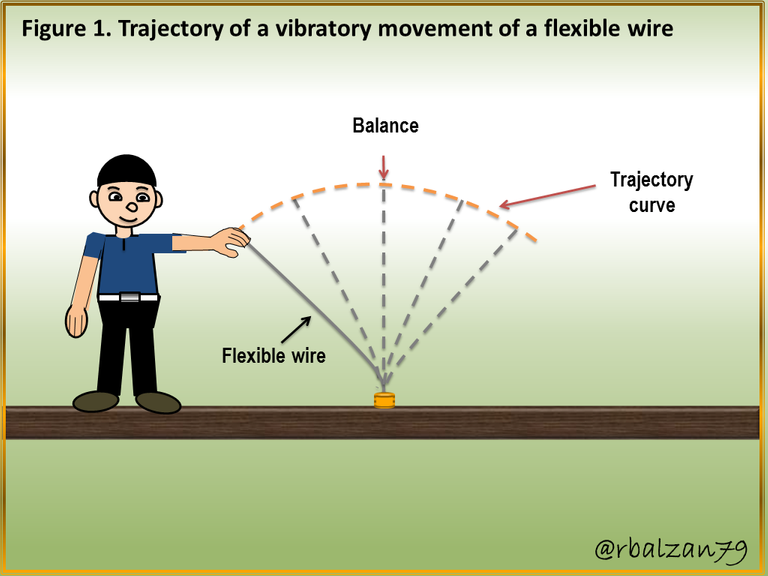
In the previous figure 1, we can observe the oscillatory characteristic of a vibratory movement but the path of the same one is even faster as it has been expressed, a daily example similar to the previous one represents the fact when we bend for the free end the vertical and flexible antenna of a car and then we release it, we will observe similar vibratory movement carried out by the wire.
The trajectory of this type of movement could also be analyzed from the point of view of a simple harmonic movement, since generally this type of movement is a periodic or harmonic movement, this allows us to analyze it through curves of periodic or harmonic behavior as it is the case of the sine and cosine functions, as we can observe in the following figure 2.
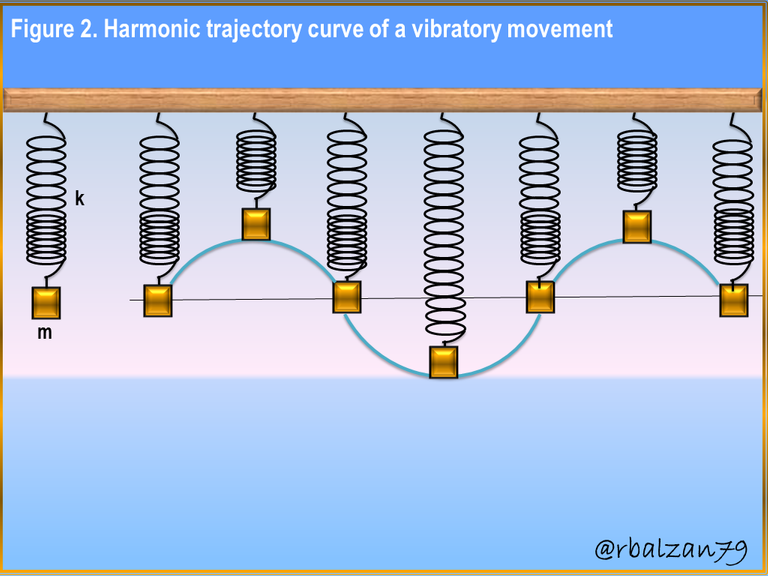
In a harmonic vibratory movement the period (T) of oscillation is configured by the time used by a certain system to be able to complete a complete vibration and its formulation is the following:

As for the frequency of oscillation we can say that it represents the number of vibrations carried out per unit of time, therefore, it constitutes the reciprocal of the period (T), its equation is the following:

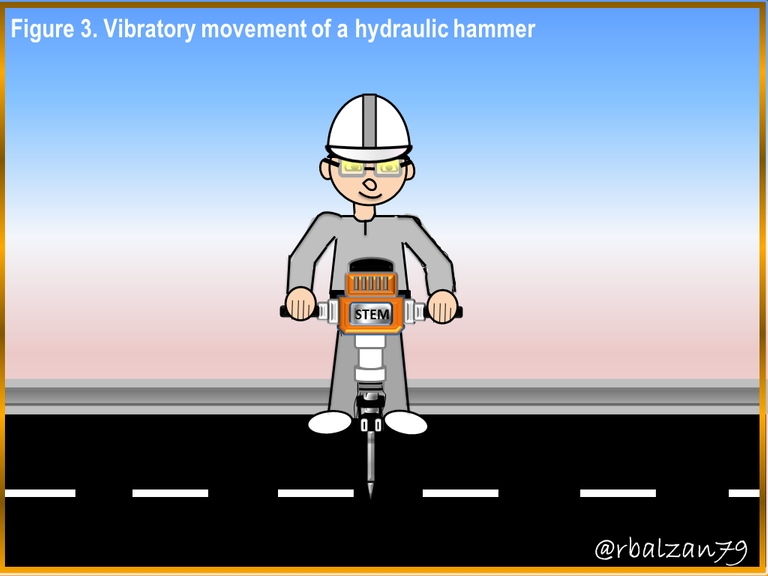
We could find innumerable vibratory movements around us, one of them representing the action of using a hydraulic hammer to break or disintegrate a certain surface as we can see in the following figure 3.
Our majestic nature gives us the pleasure of being able to observe beautiful living species which manage to perform this type of vibratory movement as we can see in the following figure 4.
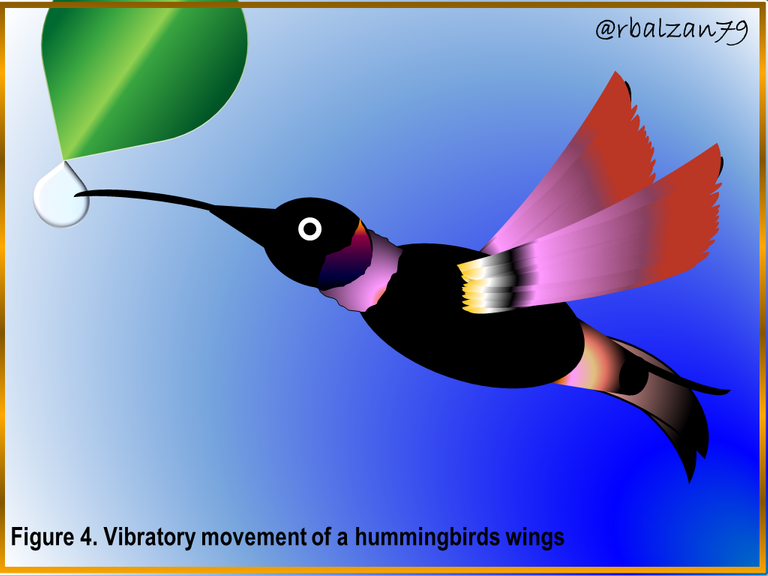
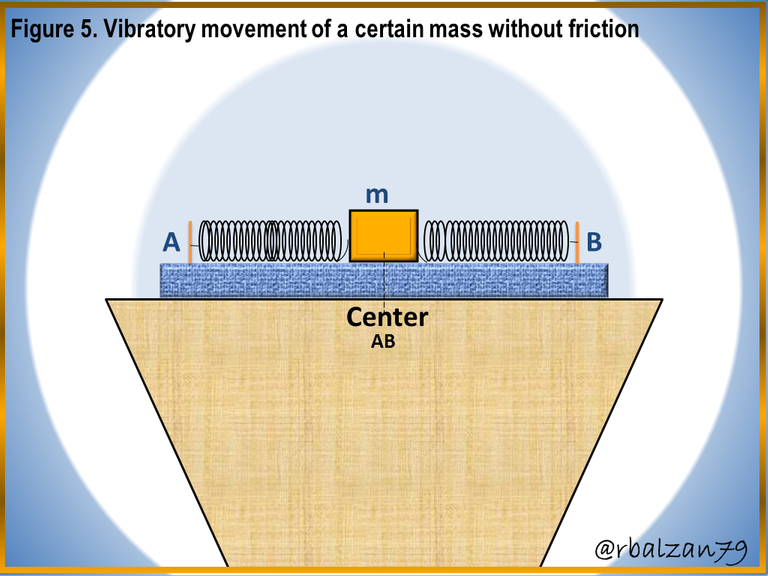
Spectacular vibratory movement observed in figure 4, we can also relate to another example, and it is represented by the action or movement that has a mass (m) which we can support without any type of friction on a horizontal plane and the same tied to two similar springs in points A and B, this mass will be in balance when placed in the center of these points (A and B), as seen in the following figure 5.
Conclusion
We continue extending the compass about the different types of movements developed in our environment, where, we find the periodic movements (and their harmonic curves) as they represent the uniform circular movements, oscillatory and vibratory, these united to other nonperiodic mobilities and which we have denominated movements bases achieve to base to any form of movement in our universe.It is important to point out that a certain vibratory movement carried out by a particle, body or object in the same way as the different movements previously analyzed, necessarily describes, travels or draws its trajectory and it will occupy the geometric place of a certain figure or geometric form.
The vibratory phenomenon is present among the activities related to humanity, and this phenomenon manifests itself in different ways and at any moment of our existence, for example, like not thinking about the vibrations that can originate when hitting a soccer ball with our feet which we witness due to the sound that reaches our ears by means of sound waves.
Also as not pointing out the strong discomfort we feel when a mosquito reaches our ears, as they make a sharp sound which is generated by the rapid flapping of their wings thus achieving that they vibrate hundreds of times per second, usually the natural vibrations of small objects or bodies are usually very fast compared to larger objects or bodies.
It is impressive to see how our own body is an extraordinary receptacle or recipient of different types of vibrations, because our main organ beats, we hear and speak by the vibration of our eardrums and larynges, when we are cold we shiver, the light waves which allow us to see are originated by some type of vibration, the essential and vital atoms that form the molecules of all our body vibrate.
Therefore, we can affirm that the study of the phenomenon of the movement besides pleasantly complex is magnificently useful and necessary to understand as much our existence as survival in this home called Earth, where the same one in equal form depends on different types from movements for its suitable balance.
We can emphasize that although not all the vibratory movements that are developed in our environment are harmonic, nevertheless, to keep narrow relation this movement with the oscillatory one, this does that the simple harmonic movement (M.A.S) represents an essential descriptive model of innumerable vibrations present in our infinite universe.
We must emphasize that we continue to see that in many of our daily activities are present a series of intrinsic movements, and that allow us to place them as practical examples in the development of our lives, and likewise the types of trajectories traveled which will always be represented by the geometric place of any important figure.
Until another opportunity my appreciated friends and readers of steemit, especially to the members of the communities friends of #steemstem and #curie for which I recommend widely to be part of these exemplary projects, since they highlight the valuable work of the academy and the scientific field.
Note: All images were made using the Paint, Power Point and animated gif applications with the PhotoScape application.
Bibliographic References
[1] Charles H. Lehmann. Analytic geometry.
[2] Lior M. Burko and Richard H. Price. Department of Physics, University of Utah, Salt Lake City.
[3] Snapper, E., Troyer, R.J. Metric Affine Geometry. Dover, New York, 1971.
[4] Raymod A. Serway y John W. Jewett, Jr. Ed. Thomson. Physical. Edición 1 y 3.
[5] Ralph E. Blake. Chapter 2, Basic vibration theory.
[6] Physics for Science and Engineering. Raymond A. Serway, Robert J. Beichner. 5ta edición.
0
0
0.000
To listen to the audio version of this article click on the play image.

Brought to you by @tts. If you find it useful please consider upvoting this reply.
Excelente!
Thank you, brother, for your visit. Greetings.
@tipu curate
Posted using Partiko Android
Upvoted 👌 (Mana: 10/25 - need recharge?)
Thank you friend @ritch for your important support. A brotherly greeting.
Hello,
Your post has been manually curated by a @stem.curate curator. @alby2 .
We are dedicated to supporting great content, like yours on the STEMGeeks tribe.
If you like what we are doing, please show your support as well by following our Steem Auto curation trail.
Please join us on discord.
Thank you for your valuable support. Greetings.
Congratulations @rbalzan79! You received a personal award!
You can view your badges on your Steem Board and compare to others on the Steem Ranking
Thank you for the information. Greetings.
Excellent explanation of the different real-life examples about vibratory movement @rbalzan79. Thanks for sharing
Thanks @carlos84 for your visit and your good comment. Greetings.
This post has been voted on by the SteemSTEM curation team and voting trail. It is elligible for support from @curie and @minnowbooster.
If you appreciate the work we are doing, then consider supporting our witness @stem.witness. Additional witness support to the curie witness would be appreciated as well.
For additional information please join us on the SteemSTEM discord and to get to know the rest of the community!
Thanks for having used the steemstem.io app and included @steemstem in the list of beneficiaries of this post. This granted you a stronger support from SteemSTEM.
Thanks to the communities of @SteemSTEM, @curie y minnowbooster for the support received