03-04-2026-Technologies and Production Systems - Transformations [EN]-[IT]


~~~ La versione in italiano inizia subito dopo la versione in inglese ~~~
ENGLISH

03-04-2026-Technologies and Production Systems - Transformations [EN]-[IT]
With this post, I would like to provide a brief introduction to the topic mentioned above.
(lesson/article code: QE_02)
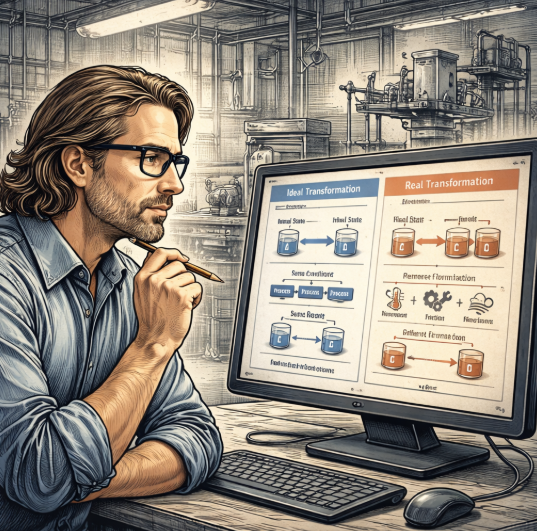
Image created with artificial intelligence, the software used is ChatGPT
Introduction to Transformations

Image created with artificial intelligence, the software used is ChatGPT
Let's start with the concept of an ideal transformation.
A transformation is defined as ideal when the initial and final states are uniquely defined
In technologies and production systems, transformations are operations that modify one or more properties of a material over time.
These properties can be, for example, geometry, strength, ductility, or other material attributes.
It is important to understand that the change occurs following a certain transformation trajectory.
Ideal and Real Transformations

Image created with artificial intelligence, the software used is ChatGPT
Below are the brief definitions of ideal transformation and real transformation:
Ideal transformation
The initial and final states are uniquely and deterministically defined; therefore, repeating the process under the same conditions yields the same results.
actual transformation
In addition to theoretical transformation, external factors that can introduce differences in the final result are also considered, even if the operations performed appear identical.
We can attempt to simplify the concepts and state that in Technologies and Production Systems, a transformation is the passage of a material from an initial state to a final state, with a change in its characteristics and, generally, an increase in its added value, until reaching a semi-finished or finished product.
Important Notes
Below are some conceptual notes or nuggets.
-A transformation is defined as precise when the range of possible solutions obtainable through the transformation is smaller than the tolerance range.
-In manufacturing (or parts production), fabrication consists of all the processes that modify the shape, dimensions, and/or surface finish of individual parts.
Below is an image that attempts to explain this concept.

Image created with artificial intelligence, the software used is ChatGPT
-Manufacturing is characterized by final products composed of a finite number of discrete components or parts.
-Caution! It is incorrect to think as follows.
In a real transformation, disturbances occur, implying that the final result is never unique, but varies outside a certain range of possible solutions. This is incorrect because acceptable variability is considered to be within a range.
-A transformation is defined as ideal when both the initial and final states are uniquely defined.
Conclusions
Transformations are at the heart of manufacturing processes, as they allow one or more properties of a material to be modified over time, such as geometry, strength, ductility, or surface texture, to obtain a semi-finished or finished product with greater added value.
The ideal transformation is a theoretical, perfectly deterministic model.
Actual transformation takes into account disturbances, initial variability, and the inevitable uncertainties of the industrial process.
Historical Notes and Questions
Historically, material transformations originate with the first human artisanal activities: metal smelting, hot deformation, cutting, and manual finishing.
Did you know that for centuries, transformation was linked to the experience of the artisan, who modified the raw material with techniques passed down empirically, without any true scientific formalization?

ITALIAN

03-04-2026-Tecnologie e sistemi produttivi - Le trasformazioni [EN]-[IT]
Con questo post vorrei dare una breve istruzione a riguardo dell’argomento citato in oggetto
(codice lezione/articolo: QE_02)
immagine creata con l’intelligenza artificiale, il software usato è ChatGPT
Introduzione sulle trasformazioni
immagine creata con l’intelligenza artificiale, il software usato è ChatGPT
Iniziamo partendo dal concetto di una trasformazione ideale.
Una trasformazione si definisce ideale quando lo stato iniziale e lo stato finale sono definiti in modo univoco
In tecnologie e sistemi produttivi le trasformazioni sono le operazioni con cui si modificano nel tempo una o più proprietà di un materiale.
Queste proprietà possono essere, per esempio, la geometria, la resistenza, la duttilità oppure altri attributi del materiale.
E' importante comprendere che la modifica avviene seguendo una certa traiettoria di trasformazione.
Trasformazioni ideali e reali
immagine creata con l’intelligenza artificiale, il software usato è ChatGPT
Qui di seguito in breve le definizioni di trasformazione ideale e di trasformazione reale:
trasformazione ideale
lo stato iniziale e quello finale sono definiti in modo univoco e deterministico; quindi, ripetendo il processo nelle stesse condizioni, si ottengono gli stessi risultati.
trasformazione reale
Oltre alla trasformazione teorica, si considerano anche le cause esterne che possono introdurre differenze nel risultato finale, anche se le operazioni svolte sembrano identiche.
Possiamo tentare di semplificare i concetti e affermare che in Tecnologie e Sistemi Produttivi, una trasformazione è il passaggio del materiale da uno stato iniziale a uno stato finale, con variazione delle sue caratteristiche e, in genere, con aumento del suo valore aggiunto, fino ad arrivare a un semilavorato o a un prodotto finito.
Note importanti
Qui di seguito alcune note o pillole concettuali.
-Una trasformazione si definisce precisa quando l'intervallo delle possibili soluzioni ottenibili tramite la trasformazione è minore dell'intervallo di tolleranza.
-Nella produzione manifatturiera (o per parti) la fabbricazione consiste nell'insieme delle lavorazioni che modificano forma, dimensioni e/o stato superficiale delle singole parti.
Qui di seguito un immagine che prova a spiegare questo concetto
immagine creata con l’intelligenza artificiale, il software usato è ChatGPT
-La produzione manifatturiera è caratterizzata da prodotti finali composti da un numero finito di componenti discreti o parti.
-Attenzione! E'errato pensare come segue.
In una trasformazione reale intervengono dei disturbi che implicano che il risultato finale non è mai unico, ma variabile all'esterno di un certo intervallo di possibili soluzioni. E' sbagliato perchè la variabilità accettabile si considera all’interno di un intervallo.
-Una trasformazione si definisce ideale quando sia lo stato iniziale che quello finale sono definiti in modo univoco.
Conclusioni
Le trasformazioni rappresentano il cuore dei processi produttivi, perché consentono di modificare nel tempo una o più proprietà di un materiale, come geometria, resistenza, duttilità o stato superficiale, per ottenere un semilavorato o un prodotto finito con maggiore valore aggiunto.
La trasformazione ideale è un modello teorico, perfettamente deterministico.
La trasformazione reale tiene conto dei disturbi, delle variabilità iniziali e delle inevitabili incertezze del processo industriale.
Cenni storici e domande
Storicamente, le trasformazioni dei materiali nascono con le prime attività artigianali dell’uomo: fusione dei metalli, deformazione a caldo, taglio e finitura manuale.
Sapevate che per secoli la trasformazione è stata legata all’esperienza dell’artigiano, che modificava la materia prima con tecniche tramandate empiricamente, senza una vera formalizzazione scientifica?
THE END
A proposito di conoscenza empirica, mi viene in mente il padre del mio amico Miguel. Quest'uomo non ha bisogno di altro che di guardare e sa quando pioverà o no, cosa che molti meteorologi non riescono a fare nemmeno usando strumenti diversi.È incredibile quanto bene quest'uomo riesca a prevedere le cose, e non sbaglia mai.
Ciao lupega,
Adoro questa tipologia di persone. Persone che hanno un grado elevatissimo di esperienza e sanno comprendere certe situazioni in maniera dettagliata in tempi brevissimi. In questo post parlo delle trasformazioni. Le trasformazioni rappresentano il nucleo fondamentale dei sistemi produttivi, poiché consentono di convertire materie prime ed energia in prodotti utili.
Esse comprendono processi fisici, chimici ed energetici e sono alla base di ogni attività industriale. Queste trasformazioni servono a creare valore economico, modificare la forma e rendere utilizzabili le risorse naturali. A presto
!BEER
View or trade
BEER.Hey @lupega, here is a little bit of
BEERfrom @stefano.massari for you. Enjoy it!Learn how to earn FREE BEER each day by staking your
BEER.come sempre ideale e reale non sempre coincidono, serve sempre una buona fase pratica per mettere a punto l'ideale
Ciao davideownzall,
grazie per aver lasciato un commento. Nel contesto di Tecnologie e Sistemi Produttivi, le trasformazioni sono i processi attraverso cui un input viene convertito in un output. L’input ad esempio potrebbero essere materie prime, energia o anche informazioni, mentre l’output è il prodotto finito o semilavorato. Possiamo dire che le trasformazioni rappresentano il nucleo fondamentale dei sistemi produttivi ed è bene comprendere nei dettagli la trasformazione reale più che quella ideale. Il rischio è di avere una qualità o un costo inaspettato.
!BEER
View or trade
BEER.Hey @davideownzall, here is a little bit of
BEERfrom @stefano.massari for you. Enjoy it!We love your support by voting @detlev.witness on HIVE .