How Will Smartphones Change in the Next 10 Years?

Smartphones have already changed the way we communicate, work, learn, shop, take photos, and entertain ourselves. But the smartphones of today may look very different from the devices we use ten years from now.
https://cdn.steemitimages.com/DQmWdy9uHxABvS5528hyBJ9VBxREXYDs3dbdLxPygMi2Q2s/1000008830.png
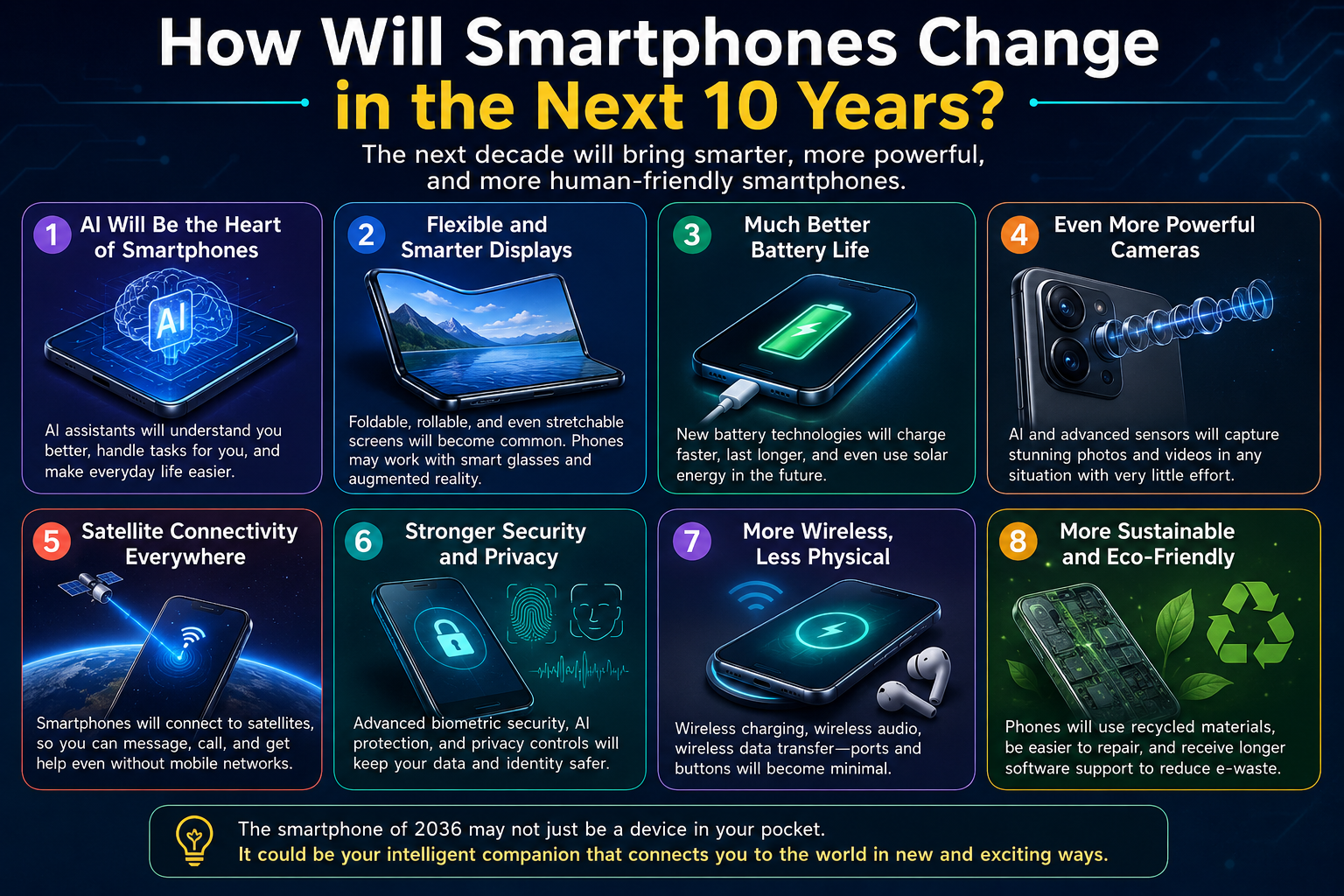
Between 2026 and 2036, smartphones are likely to become more intelligent, more connected, more energy-efficient, and possibly less dependent on traditional screens.
## Artificial Intelligence Will Become the Heart of the Smartphone
One of the biggest changes will probably be the role of artificial intelligence.
Today, we use separate apps for searching, writing, translating, editing photos, navigation, and many other tasks. In the future, AI may connect all these functions together.
Instead of opening an app and searching for information, we may simply tell our phone what we want.
For example:
> "Find me the cheapest way to travel to Lahore next weekend and prepare everything for me."
The phone could search, compare options, make a plan, and present the results without requiring us to manually open several applications.
## Screens Could Become Flexible
Foldable phones are already showing us that screens do not have to remain flat. Over the next decade, we could see rollable, stretchable, and even more flexible displays.
A device might be small enough to fit comfortably in a pocket but expand into a large screen when needed.
We may also see smartphones that work together with smart glasses and other wearable devices.
## Batteries Could Improve Significantly
Battery life has always been one of the biggest challenges for smartphones.
Future phones could use new battery technologies that provide greater capacity, faster charging, longer lifespan, and improved safety.
Imagine charging your phone for only a few minutes and having enough power for the entire day.
## Cameras Will Become Even More Powerful
Smartphone cameras have already replaced many traditional compact cameras for everyday photography.
Over the next ten years, cameras could become even more advanced.
AI could automatically improve lighting, remove unwanted objects, stabilize video, enhance sound, and produce professional-looking photographs with very little effort.
## Smartphones May Become More Connected to Satellites
Satellite connectivity could become an important part of future smartphones.
In remote mountains, deserts, oceans, and rural areas, traditional cellular coverage can be limited.
Future smartphones may communicate with satellites more easily, allowing people to send messages, share their location, or access emergency services even when conventional mobile networks are unavailable.
## Security Could Become More Advanced
Future devices could use combinations of facial recognition, fingerprints, voice recognition, behavioral patterns, and AI-based security systems.
Privacy will also become increasingly important as smartphones become more aware of our surroundings and personal habits.
## Physical Ports May Become Less Important
Wireless technology is likely to continue replacing physical connections.
Charging, headphones, file transfers, and other functions could increasingly rely on wireless systems.
Some future smartphones may have very few physical buttons or ports.
## Smartphones Could Become More Environmentally Friendly
Manufacturers may focus more on recycled materials, repairable designs, longer software support, and replaceable batteries.
Instead of buying a completely new phone every two or three years, people may keep the same device for much longer.
## Will Smartphones Still Look Like Smartphones?
By 2036, the "smartphone" might not even look like the rectangular device we know today.
It could become part of a larger ecosystem involving smart glasses, watches, earbuds, vehicles, home devices, and AI assistants.
The phone may remain in our pocket, but we may interact with it less directly.
The next ten years could bring some of the biggest changes in smartphone technology.
Artificial intelligence, flexible displays, better batteries, advanced cameras, satellite communication, stronger security, and wearable technology could completely transform how we use our devices.
The smartphone of 2036 may not simply be a faster version of today's phone. It could become a highly intelligent personal assistant that connects us with the digital world without requiring us to constantly hold and look at a screen.
What do you think smartphones will look like in 2036? Will we still carry phones in our pockets, or will smartphones evolve into something completely different?
#technology #smartphone #artificialintelligence #future #innovation #gadgets #tech #digital