China's large-scale robotic training centers.

China's large-scale robotic training centers.

![image.png]()


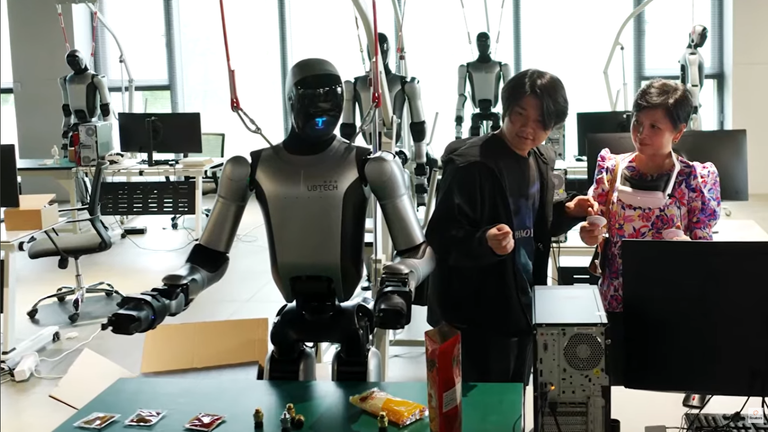
Reuters reported that China is working to transform humanoids—currently capable of impressive demonstrations—into machines fast and reliable enough for factory work; to address this, the country is establishing large centers dedicated specifically to training these machines. At a facility in southern China visited by Reuters, more than 100 humanoids stand in rows while human trainers use headsets and controllers to teach them tasks.


Operators view the environment from the robot's perspective and demonstrate movements that are subsequently used as training data. Humans practice activities such as sorting boxes, packing food, and making coffee. UBtech won a contract worth approximately $18 million to supply humanoids and other equipment for the center, but the process highlights the need for further technological evolution; according to employees interviewed by Reuters, a novice trainer might need to make around 300 attempts to produce a single usable movement.


An experienced operator manages to achieve one successful attempt out of every 50; for certain simple tasks, the humanoid robots observed in the report operated at only 20% of the speed or productivity of a human. Despite these limitations, some commercial applications are beginning to emerge. Gabot is already using its robots in pharmacies across more than two dozen Chinese cities; upon receiving a digital order, the robot navigates the store, identifies the medication, and retrieves the product from the shelf.


The system employs cameras—including one mounted on the wrist—along with a gripper and a suction cup to handle various types of packaging. According to Gabot, each product can be located and prepared in approximately one minute with a success rate exceeding 95%. Unitree’s strategy differs; its G1 model—a smaller, more accessible unit—had reached a cumulative production total of approximately 11,000 units by mid-2026. A significant portion of these robots continues to be used for research, education, development, and demonstrations.


Leju also features in this ecosystem with its Quabo series, which is used in facilities dedicated to data generation and humanoid training. Meanwhile, a parallel race is underway to improve the intelligence controlling these machines.


Sorry for my Ingles, it's not my main language. The images were taken from the sources used or were created with artificial intelligence


Posted Using INLEO


0
0
0.000
1 comments
avatar

Thanks for your contribution to the STEMsocial community. Feel free to join us on discord to get to know the rest of us!

Please consider delegating to the @stemsocial account (85% of the curation rewards are returned).

Consider setting @stemsocial as a beneficiary of this post's rewards if you would like to support the community and contribute to its mission of promoting science and education on Hive. 
 

0
0
0.000
