Running Beijing, the world's first human-robot marathon

avatar

Running Beijing, the world's first human-robot marathon
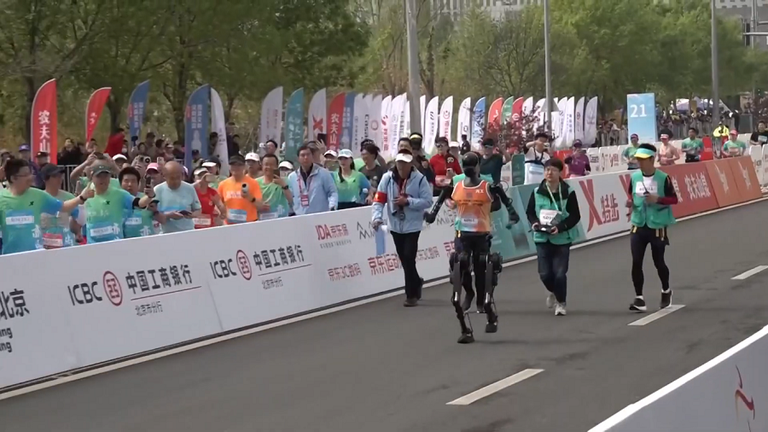


Image source:


Run with legs like a human


The long-awaited Chinese marathon where humanoid robots running alongside humans finally happened and it was not a simulation, it was an official race with 21 km of resistance, sweat, falls, stumbles and at the end a robot crossing the finish line in a historic way.


The name of the winner is Tiangong Ultra, a 1.80 cm tall humanoid designed in China and is rewriting what artificial movement means, unlike robots with wheels or tracks, the challenge here was pure biomechanical realism, weighing about 52 kg and equipped with autonomous balance software Tiangong Ultra maintained a constant pace of 10 km/h with speed peaks around 12 km/h.


Challenging the limits of biomechanics.


All this using real sports shoes specially developed to absorb impact and guarantee stability, behind the performance there is a sophisticated motor control system, plantar pressure sensors and a movement model trained in weeks of simulations, during the 21 km of the marathon in Beijing the robot needed to change batteries only three times. Its light but resistant structure combined with long legs and an efficient stride strategy allowed it to complete the test in 2 hours and 40 minutes.


It is not a record time among humans, but it is a historic feat among robots. Other competitors were not so lucky, falls at the start, collisions with railings and even robots that needed physical assistance from their operators and touching on that point, all the robots were monitored by human operators but the Tiangong Ultra impressed with its autonomy and stability when running.


The built-in AI managed to adapt its race to different surfaces: flat terrain, slight climbs, curves to the left and right, according to its creator, no Western company has achieved this level of sports performance in humanoids, the balance pressure, dynamic motor control and the ability to respond in real time make this robot one of the most advanced on the planet and bipedal movement.


This type of technology goes far beyond symbolic competitions, it opens doors for search and rescue robots, dynamic urban environments and even physical assistance in unpredictable environments. The race served as an extreme test of endurance, but also as a living laboratory for the development of future robotic applications, whether in industry, security or assisted mobility.


References 1 References 2


Follow my publications with the latest in artificial intelligence, robotics and technology.
If you like to read about science, health and how to improve your life with science, I invite you to go to the previous publications.


0
0
0.000
0 comments