Obra de toma. Secciónes de excavación. Séptimo dia de trabajo/Intake structure. Excavation sections. Seventh day of work

Buenos dias Hive. Saludo para todos.
En el día de ayer, en sesión de trabajo, entregué al Ingeniero Civil las dimensiones de la obra de toma, o sea su diseño hidráulico.Con esa información, el proyectista estructural diseñará el espesor de los muros, la tapa y la columna superior. Determinará qué resistencia debe tener el hormigón, el refuerzo de los aceros en los muros y las columnas, así como el tipo de acero con el que armará el hormigón y las cantidades de estos materiales.
Entregué al Ingeniero proyectista mecánico las dimensiones de la compuerta; ahora él determinará el espesor de las planchas, los anclajes y todos los detalles necesarios para, en un taller de fabricación, elaborar esas compuertas. Además, determinará las características del motor que se requiere para elevar las mismas. El ingeniero proyectista eléctrico tiene entonces la tarea de elaborar los planos eléctricos con la instalación y alimentación de ese motor.
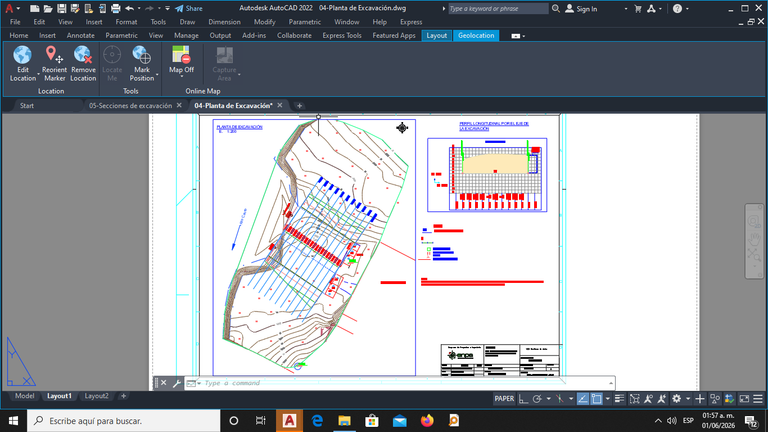
Casi ya terminando mi trabajo, en este séptimo día, les comparto la planta de excavación con las secciones de corte y las secciones transversales. Esta información es crucial. En ella se recogen el cómo y cuánto tiene que excavar en el terreno el constructor para entonces empezar a construir.
Para que el lector entienda, la vista en planta es como si estuviéramos mirando, por ejemplo, una barra de pan desde arriba, y las secciones transversales es como cortar el pan, coger uno de los pedazos, rotarlo y ponerlo frente a mí, y entonces ahí estaríamos apreciando el ancho del pan, información que, por supuesto, no se vería desde la planta.
Hacer estos planos de excavación hoy en día es muy cómodo y rápido con el uso de tecnologías GIS, CAD, BIM. En nuestro caso, usamos el AutoCAD Civil 3D; en cuestión de medio día de trabajo, bien revisado, hacemos lo que hace unos 25 o 30 años atrás nos tomaría 15 o 20 días hacer. No va a tardar mucho que con IA se haga esto en segundos, pues claro que se podrá.
Ya de mi parte, resta elaborar el listado de materiales para confeccionar el presupuesto y la memoria descriptiva de este proyecto, donde se da explicación de todos los detalles de construcción, normativas y demás.
Hasta la próxima Hive y que tengan todos feliz inicio de semana.
‐----------------------------------------‐------------
Good morning Hive. Greetings to everyone.
Yesterday, during a work session, I handed over the dimensions of the intake structure to the Civil Engineer—meaning its hydraulic design.With this information, the structural designer will design the thickness of the walls, the cover, and the upper column. They will determine what strength the concrete must have, the steel reinforcement in the walls and columns, as well as the type of steel with which the concrete will be reinforced and the quantities of these materials.
I handed over the dimensions of the gate to the mechanical design Engineer; now he will determine the thickness of the plates, the anchors, and all the necessary details to manufacture those gates in a fabrication workshop. Furthermore, he will determine the characteristics of the motor required to lift them. The electrical design engineer then has the task of developing the electrical blueprints for the installation and power supply of that motor.
Almost finishing my work now, on this seventh day, I am sharing with you the excavation plan along with the cross-sections and profile cuts. This information is crucial. It shows exactly how and how much the builder has to excavate in the ground to then begin construction.
For the reader to understand, the plan view is as if we were looking at, for example, a loaf of bread from above, and the cross-sections are like slicing the bread, taking one of the pieces, rotating it, and placing it right in front of me; only then would we be appreciating the width of the bread, information that, of course, would not be visible from the plan view.
Making these excavation plans nowadays is very convenient and fast using GIS, CAD, and BIM technologies. In our case, we use AutoCAD Civil 3D; in a matter of half a day's work, well-reviewed, we do what about 25 or 30 years ago would have taken us 15 or 20 days to do. It won't be long before this is done in seconds with AI, because of course it will be possible.
For my part, it only remains to prepare the materials list to draft the budget and the descriptive memory of this project, which explains all the construction details, regulations, and so on.
Until next time, Hive, and have a great start to the week, everyone.

Congratulations @multiingeniero! You have completed the following achievement on the Hive blockchain And have been rewarded with New badge(s)
Your next target is to reach 1500 upvotes.
Your next target is to reach 300 upvotes.
Your next target is to reach 200 comments.
You can view your badges on your board and compare yourself to others in the Ranking
If you no longer want to receive notifications, reply to this comment with the word
STOPCheck out our last posts:
Thanks for your contribution to the STEMsocial community. Feel free to join us on discord to get to know the rest of us!
Please consider delegating to the @stemsocial account (85% of the curation rewards are returned).
Consider setting @stemsocial as a beneficiary of this post's rewards if you would like to support the community and contribute to its mission of promoting science and education on Hive.