Red pumpkin bug (Coridius ianus)

| Latin Name | Observation Date | Location |
|---|---|---|
| Coridius ianus | Sep 06, 2026 | Natore, Bangladesh |

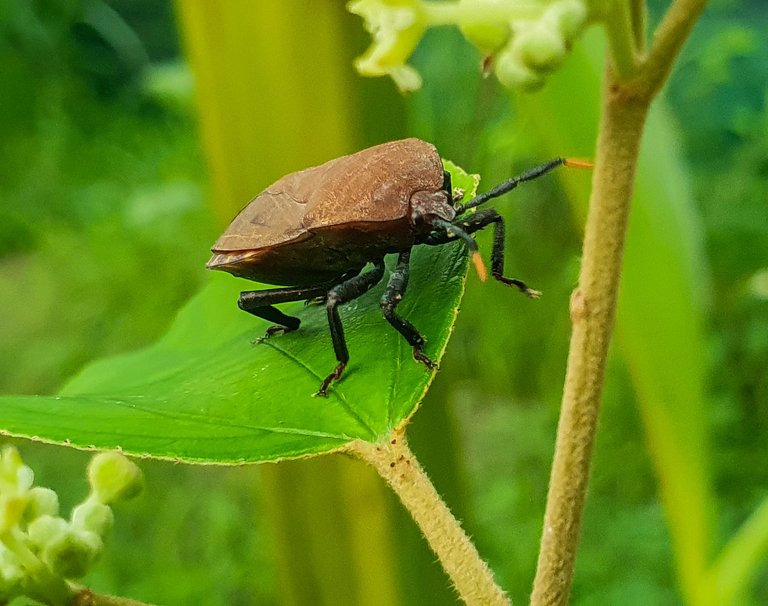
I really enjoy observing the lives of small animals hidden in nature from a close distance. While observing the trees in my garden, I saw a strange and beautiful insect on the leaves of the tree. The body color of the insect is yellowish-orange-red. When I got closer, I saw that it is basically a type of bedbug or bug. In English, they are called 'Red pumpkin bug'. Without delay, I captured the scene on my mobile camera.

Scientific name:
This interesting insect has a specific scientific name. It is known to scientists as Coridius ianus. In 1775, scientist Fabricius first named it Cimex ianus. Later, it was transferred to different genera by different scientists at different times, but in 1924, scientist Schumacher finally included it in the genus Coridius.
Family Genus:
According to the scientific classification of biology, it is a member of the Dinidoridae family. In the scientific world, their genus name is Coridius.

Physical structure and behavior:
As you can see in the picture I took, their body shape is quite oval. Their body color ranges from yellowish to bright orange-red. They have a clear black spot on the front of their back and the half of their hind wings are completely black. Their antennae are divided into 5 segments. They emit a special chemical odor from their body to protect themselves, which keeps ants and other predators away.

Habitat and habitat:
In terms of geographical distribution, they are mainly residents of our tropical South and Southeast Asia. Apart from our Bangladesh, they are widely seen in neighboring countries. They are usually found more in agricultural lands, gourd and pumpkin plots and vegetable gardens.
Food and reproduction:
In terms of food habits, they mainly survive by sucking the juice from the soft parts of plants. Especially the juice of pumpkin plants such as gourd, sweet pumpkin, rice pumpkin, etc. is their main food. Their mouth muscles are very strong to suck the juice of the plant.
Benefits:
They do not have any direct benefits in the environment. However, in the natural ecosystem of agricultural land, they are a common part of the food chain and can be used as food for other predators or birds.

Disadvantages:
Although they are beautiful to look at, they are one of the most harmful insects in our cropland. They cause extensive damage to pumpkin crops. Due to sucking the juice from the soft stems and leaves of the plant, the normal growth of the crop is severely hampered and many times the plant becomes weak and dies.
I learned about them from various sites including iNaturalist, Wikipedia and Google.
(All posts are written in Bengali and translated into English using Google Translate.)
| Camera Used | Samsung SM-G973F |
|---|---|
| F-Stop | F2.4 |
| ISO speed | ISO |
| Focal length | 26mm |
| Flash | No |
| Editing app | Lightroom |
| Photography | (Coridius ianus) |
| Photographer | @mshbd |
| Location | Natore, Bangladesh |
| Link to original community |
|---|
| https://www.inaturalist.org/observations/400365312 |
| Latitude | Longitude | Map Link |
|---|---|---|
| 24.3360 | 89.1134 | https://www.openstreetmap.org/#map=12/24.3360/89.1134 |
Sending you a tip point.
Thanks for your contribution to the STEMsocial community. Feel free to join us on discord to get to know the rest of us!
Please consider delegating to the @stemsocial account (85% of the curation rewards are returned).
Consider setting @stemsocial as a beneficiary of this post's rewards if you would like to support the community and contribute to its mission of promoting science and education on Hive.