Review of Vector Functions Chapter – Concept Check & True-False Quiz

https://play.3speak.tv/embed?v=mes/2e9u7kyv
In this video, I go over the concept check questions and true-false quiz as part of the review on the vector functions chapter from my calculus book. There are 9 concept check questions and 14 quiz questions, so try them out before I go over the solutions. I also use this as an opportunity to link back to my earlier videos on vector functions, as well as the very detailed thumbnails I made throughout these videos. If you do try the questions on your own, let me know how well you did!
▶️ Watch on 3Speak - Odysee - BitChute - Rumble - Telegram - YouTube - PDF Notes - Notes - Playlist - Vector Functions - MES Links

#math #vectors #calculus #education #quiz
Timestamps
- Intro – 0:00
- Calculus book reference – 1:06
- Calculus book chapter – 1:31
- Topics to cover – 2:41
- Review: Concept Check – 3:52
- Question 1: Vector function calculus – 6:13
- Question 2: Space curves – 11:30
- Question 3: Tangent vector – 13:43
- Question 4: Differentiation rules – 18:33
- Question 5: Length of a space curve – 23:13
- Question 6: Curvature – 27:34
- Question 7: Unit normal, binormal planes, and osculating circle – 32:26
- Question 8: Velocity, speed, and acceleration – 38:01
- Question 9: Kepler's Laws – 42:42
- True-False Quiz – 45:59
- Question 1: Vector equation of a line – 49:07
- Question 2: Parabola – 50:43
- Question 3: Line through the origin – 53:11
- Question 4: Differentiation by components – 54:53
- Question 5: Derivative of cross product – 55:41
- Question 6: Derivative of the magnitude of a vector – 56:36
- Question 7: Curvature – 1:01:10
- Question 8: Binormal vector – 1:03:06
- Question 9: Curvature and inflection points – 1:05:02
- Question 10: Curvature of a straight line – 1:07:57
- Question 11: Constant magnitude of a vector – 1:11:06
- Question 12: Space curve on a sphere – 1:16:20
- Question 13: Osculating circle – 1:18:03
- Question 14: Parameterizations of a curve – 1:20:16
- Outro – 1:23:28
View Video Notes Below!
- MES Links - Donate - Telegram - @mestruth on Hive & YouTube - Hive blockchain tutorial - Video playback speed tutorial - Where Did the Towers Go? by Dr. Judy Wood + MANY more links…
- Reuse of my videos: Feel free to make use of / re-upload / monetize my videos as long as you provide a link to the original video.
- Fight back against censorship: Bookmark sites/channels/accounts and check periodically. - Archive webpages - ArcHive
Calculus Book Reference
Note that I mainly follow along the book:
- Calculus: Early Transcendentals 7th Edition by James Stewart: Link
- Note: In some earlier videos I used the 6th edition.
Calculus Book Chapter
The Hive notes and sections playlist for each video of this chapter are listed below:
- Vector Functions and Space Curves - ▶️
- Derivatives and Integrals of Vector Functions - ▶️
- Arc Length and Curvature - ▶️
- Motion in Space: Velocity and Acceleration - ▶️
- Review - ▶️ — CURRENT VIDEO
- Concept Check
- True-False Quiz
- Problems Plus
This links are also on MES Links: https://mes.fm/links
Topics to Cover
Note that the timestamps will be included in the video description for each topic listed below.
- Concept Check
- Question 1: Vector function calculus
- Question 2: Space curves
- Question 3: Tangent vector
- Question 4: Differentiation rules
- Question 5: Length of a space curve
- Question 6: Curvature
- Question 7: Unit normal, binormal planes, and osculating circle
- Question 8: Velocity, speed, and acceleration
- Question 9: Kepler's Laws
- True-False Quiz
- Question 1: Vector equation of a line
- Question 2: Parabola
- Question 3: Line through the origin
- Question 4: Differentiation by components
- Question 5: Derivative of cross product
- Question 6: Derivative of the magnitude of a vector
- Question 7: Curvature
- Question 8: Binormal vector
- Question 9: Curvature and inflection points
- Question 10: Curvature of a straight line
- Question 11: Constant magnitude of a vector
- Question 12: Space curve on a sphere
- Question 13: Osculating circle
- Question 14: Parametrizations of a curve
Review
Concept Check
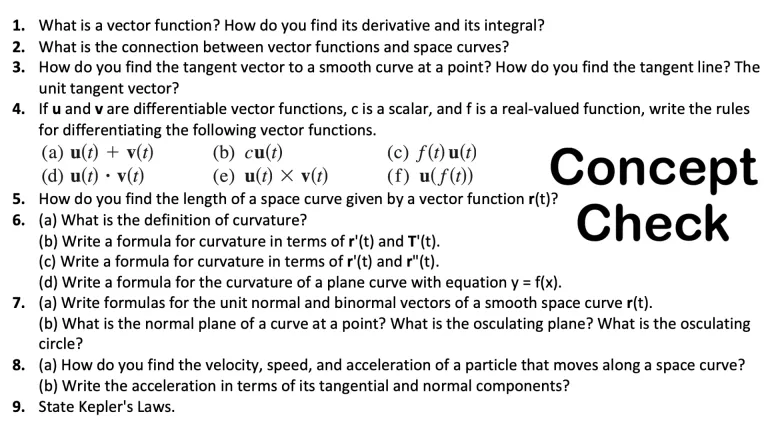
Question 1: Vector function calculus
What is a vector function?
How do you find its derivative and its integral?
Question 2: Space curves
What is the connection between vector functions and space curves?
Question 3: Tangent vector
How do you find the tangent vector to a smooth curve at a point?
How do you find the tangent line? The unit tangent vector?
Question 4: Differentiation rules
If u and v are differentiable vector functions, c is a scalar, and f is a real-valued function, write the rules for differentiating the following vector functions.

Question 5: Length of a space curve
How do you find the length of a space curve given by a vector function r(t)?
Question 6: Curvature
(a) What is the definition of curvature?
(b) Write a formula for curvature in terms of r'(t) and T'(t).
(c) Write a formula for curvature in terms of r'(t) and r"(t).
(d) Write a formula for the curvature of a plane curve with equation y = f(x).
Question 7: Unit normal, binormal planes, and osculating circle
(a) Write formulas for the unit normal and binormal vectors of a smooth space curve r(t).
(b) What is the normal plane of a curve at a point? What is the osculating plane? What is the osculating circle?
Question 8: Velocity, speed, and acceleration
(a) How do you find the velocity, speed, and acceleration of a particle that moves along a space curve?
(b) Write the acceleration in terms of its tangential and normal components?
Question 9: Kepler's Laws
State Kepler's Laws.
Solution to Question 1: Vector function calculus
What is a vector function?
How do you find its derivative and its integral?
Solution:
A vector-valued function, or a vector function, is a function whose domain is a set of real numbers and whose range is a set of vectors.
In general, a vector function in 3D space can be written in component form just like equations for lines.
That is, any vector function is of the form, where the parameter t typically denotes time:

Recall my earlier video on vector functions.

To differentiate the vector function, we differentiate each component separately to get:

To integrate the vector function, we integrate each component separately to get:

Recall my earlier video on derivatives and integrals of vector functions.

Solution to Question 2: Space curves
What is the connection between vector functions and space curves?
Solution:
A space curve is a curve in space.
There is a close connection between space curves and vector functions.
Specifically, we can determine a vector function which traces along a space curve C (provided we put the tail of the vectors at the origin, so they are position vectors).
Likewise, any vector function defines a space curve.
For example, if we have a vector function r(t) = f(t) i + g(t) j + h(t) k and we vary t, the position vector r(t) traces out the curve C.
See my earlier video on vector functions and space curves.

Solution to Question 3: Tangent vector
How do you find the tangent vector to a smooth curve at a point?
How do you find the tangent line? The unit tangent vector?
Solution:
Let C be a smooth curve with position vector r(t).
The tangent vector is r'(t).
The unit tangent vector is:

Recall my earlier video on the definition of derivative of a vector function.

Recall also my earlier video for the vector equation of a line.
Thus the vector equation of the tangent line at t = a is:

Solution to Question 4: Differentiation rules
If u and v are differentiable vector functions, c is a scalar, and f is a real-valued function, write the rules for differentiating the following vector functions.

Solution:
These are the differential rules for vector functions that I went over in my earlier video.

The derivation for each rule is illustrated in the sections video thumbnails below.
Solution to (a):

Solution to (b) and (c):

Solution to (d):

Solution to (e):

Solution to (f):

Solution to Question 5: Length of a space curve
How do you find the length of a space curve given by a vector function r(t)?
Solution:
The rate of change of the distance with respect to t is:

For a small displacement of t, the length of the line segment from r(t) to r(t + Δt) is:

When Δt → 0, the length of space curve is equal to Δs.
Therefore the length of the space curve from r(a) to r(b) is:

Recall my earlier video on the length of a space curve.


Solution to Question 6: Curvature
(a) What is the definition of curvature?
(b) Write a formula for curvature in terms of r'(t) and T'(t).
(c) Write a formula for curvature in terms of r'(t) and r"(t).
(d) Write a formula for the curvature of a plane curve with equation y = f(x).
Solution to (a):
The notion of curvature measures how sharply a curve bends.
We would expect the curvature to be 0 for a straight line, to be very small for curves which bend very little, and to be large for curves which bend sharply.
If we move along a curve, we see that the direction of the tangent vector will not change as long as the curve is flat.
Its direction will change if the curve bends.
The more the curve bends, the more the direction of the tangent vector will change.
Curvature is defined as:

Recall my earlier video on curvature.

Solution to (b):
From above:

Solution to (c):
The formula is shown below my earlier video on curvature.

Solution to (d):
The formula is shown below from my earlier video on curvature of a plane curve.

Solution to Question 7: Unit normal, binormal planes, and osculating circle
(a) Write formulas for the unit normal and binormal vectors of a smooth space curve r(t).
(b) What is the normal plane of a curve at a point? What is the osculating plane? What is the osculating circle?
Solution to (a):
The formulas for the unit normal and binormal vectors are shown below from my earlier video.

Solution to (b):
The plane formed by the normal vector N(t) and binormal vector B(t) at a point on the curve r(t) is the normal plane of this curve.
The plane formed by the unit tangent vector T(t) and the normal vector N(t) at a point on the curve r(t) is the osculating plane of this curve.
Now, if P is a point on the curve, the circle that lies in the osculating plane at P, has the same tangent as the curve at P, lies on the concave side of the curve (the side toward which the normal vector points), and has radius ρ = 1/κ (where κ is the curvature of this curve at P) is the osculating circle.
See my earlier video on the TNB frame and osculating circle.


Solution to Question 8: Velocity, speed, and acceleration
(a) How do you find the velocity, speed, and acceleration of a particle that moves along a space curve?
(b) Write the acceleration in terms of its tangential and normal components?
Solution to (a):
If the trajectory of a particle moving along a space curve is modeled by r(t), the velocity of the particle at time t will be given by the vector:

The speed of the particle at time t is the scalar:

Finally, the acceleration of the particle at time t moving along a space curve is the vector:

Recall my earlier video on moving objects in 2D and 3D.


Solution to (b):
The formulas for the tangential and normal accelerations are shown below from my earlier video.

Solution to Question 9: Kepler's Laws
State Kepler's Laws.
Solution:
Kepler's Laws of planetary motion are:
- A planet revolves around the Sun in an elliptical orbit with the Sun at one focus.
- The line joining the Sun to a planet sweeps out equal areas in equal times.
- The square of the period of revolution of a planet is proportional to the cube of the length of the major axis of its orbit.
Recall my earlier video on Kepler's Laws.

Here is also a good photo from Wikipedia showing different planets sharing the same focus, the Sun.

True-False Quiz
Question 1: Vector equation of a line
The curve r(t) = t3 i + 2t3 j + 3t3 k is a line.
Question 2: Parabola
The curve r(t) = <0, t2, 4t> is a parabola.
Question 3: Line through the origin
The curve r(t) = <2t, 3-t, 0> is a line that passes through the origin.
Question 4: Differentiation by components
The derivative of a vector function is obtained by differentiating each component function.
Question 5: Derivative of cross product
If u(t) and v(t) are differentiable vector functions, then:

Question 6: Derivative of the magnitude of a vector
If r(t) is a differentiable vector function, then:

Question 7: Curvature
If T(t) is the unit tangent vector of a smooth curve, then the curvature is:

Question 8: Binormal vector
The binormal vector is B(t) = N(t) x T(t).
Question 9: Curvature and inflection points
Suppose f is twice continuously differentiable.
At an inflection point of the curve y = f(x), the curvature is 0.
Question 10: Curvature of a straight line
If κ(t) = 0 for all t, the curve is a straight line.
Question 11: Constant magnitude of a vector
If |r(t)| = 1 for all t, then |r'(t)| is a constant.
Question 12: Space curve on a sphere
If |r(t)| = 1 for all t, then r'(t) is orthogonal to r(t) for all t.
Question 13: Osculating circle
The osculating circle of a curve C at a point has the same tangent vector, normal vector, and curvature as C at that point.
Question 14: Parametrizations of a curve
Different parametrizations of the same curve result in identical tangent vectors at a given point on the curve.
Solution to Question 1: Vector equation of a line
The curve r(t) = t3 i + 2t3 j + 3t3 k is a line.
Solution: True
If we reparameterize the curve by replacing u = t3 , we have:

This is a line through the origin with direction vector:

Solution to Question 2: Parabola
The curve r(t) = <0, t2, 4t> is a parabola.
Solution: True
Parametric equations for the curve are:

This is an equation of a parabola in the yz-plane.
Solution to Question 3: Line through the origin
The curve r(t) = <2t, 3-t, 0> is a line that passes through the origin.
Solution: False
The vector function r(t) represents a line, but the line does not pass through the origin.

Solution to Question 4: Differentiation by components
The derivative of a vector function is obtained by differentiating each component function.
Solution: True
See my earlier video on the derivative of vector functions by components.

Solution to Question 5: Derivative of cross product
If u(t) and v(t) are differentiable vector functions, then:

Solution: False
See my earlier video on the derivative of a cross product of vector functions.

Solution to Question 6: Derivative of the magnitude of a vector
If r(t) is a differentiable vector function, then:

Solution: False
For example:

Recall the equation for the length of a vector in 2D (and 3D) from my earlier video.

Also recall the Pythagorean Identity from my earlier video.

Solution to Question 7: Curvature
If T(t) is the unit tangent vector of a smooth curve, then the curvature is:

Solution: False
The curvature is the magnitude of the rate of change of the unit vector with respect to arc length s, not with respect to t, as described in my earlier video.
Solution to Question 8: Binormal vector
The binormal vector is B(t) = N(t) x T(t).
Solution: False
As shown in my earlier video, the binormal vector is B(t) = T(t) x N(t).

Recall from my earlier video that switching the order of the cross product obtains the negative value.


Solution to Question 9: Curvature and inflection points
Suppose f is twice continuously differentiable.
At an inflection point of the curve y = f(x), the curvature is 0.
Solution: True
At an inflection point where f is twice continuously differentiable we must have f''(x) = 0, thus the curvature is 0 there by my earlier video.
Recall my earlier video on inflection points and concavity.

A continuous function that changes concavity means that at the inflection point the 2nd derivative (aka acceleration) is zero.


Solution to Question 10: Curvature of a straight line
If κ(t) = 0 for all t, the curve is a straight line.
Solution: True

If the tangent vector is a constant vector, then the curve must be a straight line.
Recall my earlier video on curvature.

Solution to Question 11: Constant magnitude of a vector
If |r(t)| = 1 for all t, then |r'(t)| is a constant.
Solution: False
If r(t) is the position of a moving particle at time t and |r(t)| = 1, then the particle lies on the unit circle or the unit sphere, but this does not mean that the speed |r'(t)| must be constant.
As a counterexample:

Solution to Question 12: Space curve on a sphere
If |r(t)| = 1 for all t, then r'(t) is orthogonal to r(t) for all t.
Solution: True
See my earlier video of the curve on a sphere.

Solution to Question 13: Osculating circle
The osculating circle of a curve C at a point has the same tangent vector, normal vector, and curvature as C at that point.
Solution: True
See my earlier video on the osculating circle.


Solution to Question 14: Parameterizations of a curve
Different parameterizations of the same curve result in identical tangent vectors at a given point on the curve.
Solution: False
For example both vectors r1(t) = <t, t> and r2(t) = <2t, 2t> represent the same plane curve (the line y = x), but their tangent vectors are different.

In fact, different parameterizations give parallel tangent vectors at a point, but their magnitudes may differ.
Sections Playlist and Thumbnails
Notes - Playlist - Vector Functions
Review of Vector Functions Chapter – Concept Check & True-False Quiz
▶️ Watch on 3Speak - Odysee - BitChute - Rumble - Telegram - YouTube - Notes
Review of Vector Functions – Concept Check
Vector Equation of a Tangent Line on a Space Curve

Review of Vector Functions – True-False Quiz

You can check out this post and your own profile on the map. Be part of the Worldmappin Community and join our Discord Channel to get in touch with other travelers, ask questions or just be updated on our latest features.