The Birth Of A Magnetar

Astrophysicsts caught a bright and at the same time special kilonova. Most likely, two neutron stars collided yet their collisions didn’t turn them into a black hole but into a magnetar.
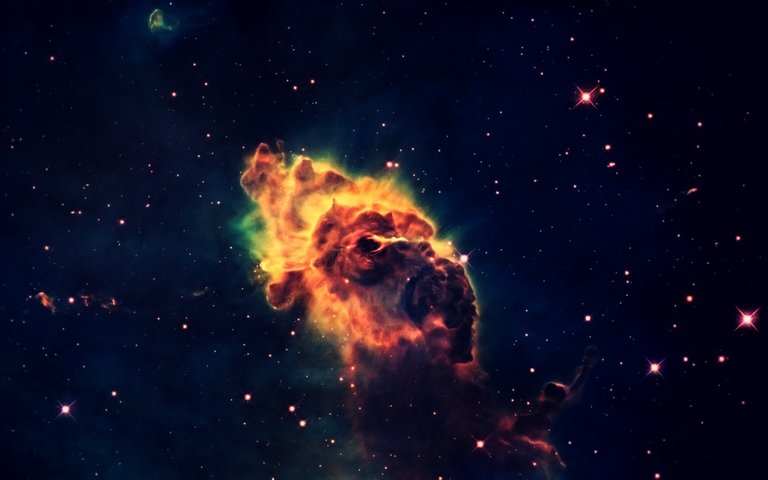
Image by WikiImages from Pixabay
- Be also sure to check out my other posts and follow me @kralizec and subscribe to my Youtube channel at Kralizec Gaming Youtube Channel
Long ago, far in the Universe, two neutron stars collided. The collision of these two already quite extreme objects fired off a gigantic explosion. A kilonova. In a fraction of a second as much energy in form of gamma-radiation was released as would our Sun radiate over its whole lifespan that is 10 billion years long. This is called a gamma-ray burst.
A team of astrophysicists led by experts from the Northwestern University in America studied the radiation of this explosion in the visible, x-ray, infrared, and radio-wave spectra. Finally, they came to the conclusion that we witnessed the birth of a magnetar – an extreme neutron star surrounded by incredibly strong magnetic fields. Plus, it shows that this was the brightest kilonova we observed so far. It’s short gamma-ray burst with the name GRB 200522A reached Earth on the 22nd of May 2020.
As Wen-fai Fong – the research lead – said: When two neutron stars collide – something we observed in the past – we usually think that a heavy neutron star will get created. But such an object is unstable and almost immediately collapses into a black hole. But now we found out that the heavy object created by the merger of two neutron stars can survive. Instead of collapsing into a black hole, a magnetar was born – a fast rotating neutron star with extreme magnetic fields.
The gamma-ray burst was first detected by the American space gamma-ray telescope Neil Gehrels Swift Observatory. It sounded the alarm and other telescopes focused on the explosion. The Hubble Space Telescope, Very Large Array, W.M. Keck Observatory, and the Las Cumbres Observatory Global Telescope. Their data showed that this kilonova is special. The infrared radiation data which came from Hubble we roughly a thousand times brighter compared to the x-ray and radio-wave radiation at least according to our current knowledge. The researchers are thinking about different options and in the end, they think the most probable explanation is the birth of a magnetar.
We already know of magnetars. We even have a few in the Milky Way. The experts think they were born during supernova explosions of massive stars. But they also thought they could be born in the mergers of neutron stars. And it seems we just witnessed such an event.
When it comes to kilonovae, these are explosions smaller than regular supernovae yet about a thousand times more powerful than regular novae. If the strong infrared radiation in this particular kilonova that was observed by Hubble was truly caused by a freshly born magnetar then in a few years the material ejected by the kilonova should shine in the radio-wave spectrum. If we do discover such radiation we will have confirmation that it is a magnetar created by a collision of neutron stars.
Sources:
- If you like the content I’m producing about science maybe you will like the content I produce about gaming as well! Be sure to check out my other posts!
https://twitter.com/Bhattg18/status/1327528550384115712
@tipu curate 2 :)
Upvoted 👌 (Mana: 0/32) Liquid rewards.