The Invisible Number That Decides Who Lives and Who Doesn’t

At 7:19 PM, everything inside the building still feels normal.
People laughing.
The music playing, nothing too loud, nothing suspicious.
The floor feels steady under everyone’s feet.
The structural system — beams, columns, connections — all still doing their job in silence.
Load goes down to the columns, columns share the load to the ground, tension and compression holding each other like they always do.
No one think anything bad going to happen.
No one looking at the ceiling.
Nobody even imagine something terrible is already inside the building, hidden inside a calculation nobody sees.
But five seconds later, the balance break.
The sound of metal failing.
The floor suddenly move.
And in just a moment, 114 people gone.
Just like that.
Without warning.
Without chance.
Not because of an earthquake.
Not because of bomb.
Not because of terrorism.
It happened because of one number that was too small. A number that lives inside engineering drawings, inside technical reports, inside math.

That number is called:
Safety Factor.
What Safety Factor Really Means
In structural engineering, the real strength of a building is not about how big the column looks from outside, or how thick the wall feels when you touch it.
It is about the distance between:
- how much load the building is expected to carry, and
- the maximum load where it will completely collapse.
The formula is actually simple:
Safety Factor = Ultimate Capacity / Working Load
But the reality behind that number is not simple at all.
SF = 2 → still have room for mistakes.
SF = 1.3 → danger starts to get close.
SF = 1.1 → a single crack can start the collapse.
SF = 1.0 → mathematically, failure is already waiting.
Engineers sometimes look too carefully, too strictly, too annoyingly at details.
But the truth is simple:
Gravity doesn’t negotiate.
Gravity doesn’t care what people “feel”.
Gravity only cares about numbers.
When Safety Factor Drops, Lives Drop Too
Case 1 — Hyatt Regency Walkway Collapse (1981)
Location: Kansas City, USA
Investigation: National Institute of Standards and Technology


A small change during construction — just changing the hanger rod detail — and suddenly the load on one connection becomes almost double.
In the original plan, the Safety Factor may be around 2. After the modification, the Safety Factor go down to almost 1.
One connection reaches its limit and when it fails, it doesn’t fail slowly. It fails completely, pulling the walkway down, and everyone standing on it fall with it.
It only takes a few seconds for the disaster, more than 114 lives lost. Just because one numerical margin disappeared.
Case 2 — Rana Plaza (2013)
Location: Savar
Reports: BBC, International Labour Organization
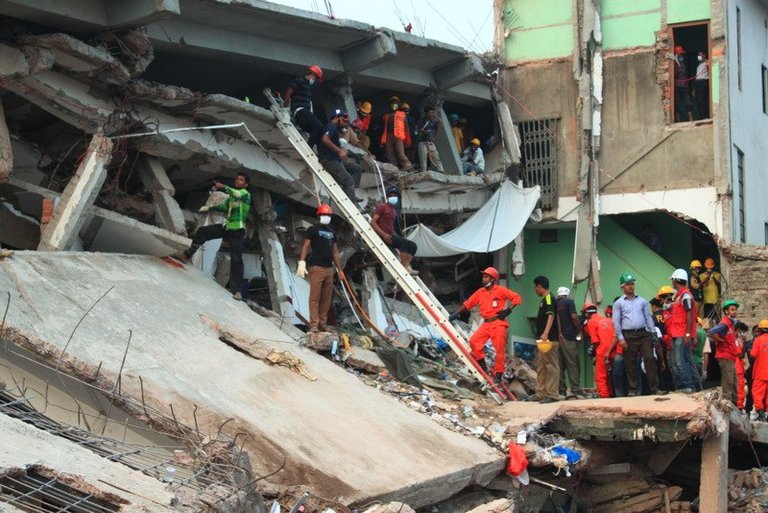
Rana Plaza was not designed to be a garment factory. The structure was made for commercial use with around 3 kN/m² live load.
But then:
Heavy sewing machines installed, generators added, and illegal extra floors built on top.
The load went from 3 kN/m² to around 6–7 kN/m².
Columns started to carry load almost at their ultimate capacity.
Safety Factor shrinks smaller and smaller, until one column finally says “I cannot hold anymore.”
And then everything follows.
Progressive collapse, floor on top of floor collapsing, more than 1,100 people died. Not because the building “looks old” but because the Safety Factor is already gone.
A Simple Technical Example
Let’s imagine a concrete column:
40 cm × 40 cm
Concrete strength = 25 MPa
Ultimate capacity ≈ 4,000 kN
Safe Condition – SF = 2.67
Working load: 1,500 kN
Even with a small mistake at the construction site, still okay.
Danger Condition – SF = 1.14
Load: 3,500 kN
Column still stands, yes, but one small crack, one misalignment, one piece of concrete that does not vibrate well… is enough to send it into failure.
Buildings never collapse because of one giant mistake; they collapse because of many small compromises that engineers warned, but people ignore.
Physics Does Not Understand “Should Be Fine.”
People often say:
“Just add one more floor, it’s okay.”
“Machine weight only a little bit heavier.”
“We cut a bit of steel to save money.”
But physics does not understand any of that, structure only understands:
- load
- capacity
- stress
- failure
When the safety factor decreases, risk doesn’t increase slowly; it increases very fast… like an exponential curve.
- At SF 2.5 → still okay if something goes wrong.
- At SF 1.2 → one mistake can be fatal.
- At SF 1.05 → even a rumor of a mistake is already dangerous.
Why This Story Matters Today
In many developing countries, we still see:
extra floors built without checking the columns, heavy machines placed without recalculation, cheaper material used to reduce cost, no proper supervision at the site, structural drawings changed “a bit”, and corruption making everything worse.
All these things, even small ones, slowly eat the Safety Factor.

And when the Safety Factor becomes close to 1, the building doesn’t scream for help. It doesn’t shake or make big warnings; it just waits and one day… something small happens, A vibration, an overload, A minor construction defect.
And then gravity finishes the story.
The Conclusion: Every Building Stands on One Invisible Number
People always admire buildings for the things we can see with our eyes — the shiny glass, the nice curves, the tall shape touching the sky, the expensive material, the modern look that make a city feel proud. But actually none of that decide who will live or who will not when the structure is pushed to its real limit. None of those beautiful things will protect a crowd when something start to go wrong deep inside the concrete or hiding inside the steel.
Because the real foundation of a building is not only concrete, not only steel, not even the architect drawing. It is one single number. Safety Factor.
This number lives quietly inside engineering calculation, hidden in pages that most people never even want to read. It is not something that gets praise on the news, nobody post it on Instagram, nobody in public talk about it unless something already feels suspicious. Most people even forget this number exist, until the moment it becomes too small and danger already sitting inside the structure.
Safety Factor is like an invisible distance between a proud building and a building that is only waiting for a failure. It is a space where human mistakes, construction errors, overloads, and small imperfections can still be survived before they turn into disaster. If this number is healthy, the building feels strong even when people use it wrong or put extra weight on it. But when this number starts to shrink — slowly, quietly, almost politely — the building becomes a different story. It becomes a risk. It becomes a countdown. A ticking clock nobody hear.
Because when load and strength become too close, when the building carries more and more weight while the resistance stay the same, collapse is not tragedy or mystery anymore. It is not bad luck, not fate, not punishment. It is only an equation finally doing what the equation must do.
When
Load ≥ Strength
The story is already written.
It is not emotional.
It is not dramatic.
It is simply mathematics doing its job the same way every time.
And gravity — maybe the most honest auditor in the world — stamps the final result without delay. Gravity never compromises, never negotiates, never say “please wait.” It only respond to numbers, and when the numbers fail, the structure follow.
This is the reason why engineers look so annoying sometimes, checking small details again and again. This is why the calculation looks strict and complicated. This is why the code books keep adding more safety rules. Because the moment the Safety Factor becomes too small, everything else — the design, the beauty, the cost — all of that becomes meaningless.

Beautiful architecture doesn’t save life.
Expensive material doesn’t save lives.
Tall buildings don’t save lives.
Only the safety margin does.
The number nobody sees, nobody talks about, nobody appreciates, until the day gravity show the truth with no mercy.
Regards your engineers @kharrazi
References :
- National Institute of Standards and Technology
https://www.nist.gov - American Concrete Institute
https://www.concrete.org - Eurocode EN 1990 – Basis of Structural Design
https://eurocodes.jrc.ec.europa.eu/sites/default/files/2022-06/EN1990_2_Gulvanessian.pdf - Eurocode EN 1992-1-1 – Concrete Structures
https://eurocodes.jrc.ec.europa.eu/showpage.php?id=138 - BBC – Rana Plaza Report
https://www.bbc.com/news/world-asia-22476774 - International Labour Organization – Rana Plaza Investigation
https://www.ilo.org/resource/news/rana-plaza-more-needs-be-done-ensure-workplace-safety - American Society of Civil Engineers – Hyatt Regency Case Study
https://www.asce.org/publications-and-news/civil-engineering-source/civil-engineering-magazine/article/2007/01/the-hyatt-regency-walkway-collapse
If you like English literature, your mind will be blowed by this: [Literature] Charles Dickens: A Great Mystery Solved by Gillan Vase 1/131