Anomalies of our planet.

avatar

Anomalies of our planet.


The anomaly under Antarctica, or the largest gravitational anomaly on Earth, is a recent study, it was published at the end of December, it has been made public these days, in these days of February. In this study they do not explain where the anomaly arose from, but rather they have reconstructed 70 million years of the evolution of this anomaly, an evolution because curiously it has changed in terms of its position and also its intensity.


Although the headlines talk about the largest gravitational anomaly on Earth, in reality the record is still held by the gravitational anomaly of the Indian Ocean, below you see both, by the way, the one in graph A would be marked with a star, the one in the Indian Ocean, south of India, and in graph B, in the south, we have the one in Antarctica, they are gravitational wells, what happens is that the Antarctic anomaly is the most intense negative gravitational anomaly when the rotation effect is corrected and the polar flattening, because you already know that the Earth is a little flattened at the poles, a little, I think it is 24 kilometers of difference in terms of the Equator, it is a little, it is something verifiable and measurable.


Souce


It can be said that the two anomalies are winners, although in different categories, and both hide many mysteries about what is under our feet, what is under the Earth's crust, because what is under there, what we have under our feet, is much more complex than was believed until a few years ago and apparently affects what happens on the surface more than was believed. The Indian Ocean anomaly covers approximately 3 million square km and produces a depression of up to -106 m. That is, the water there is 106 m below mean sea level.
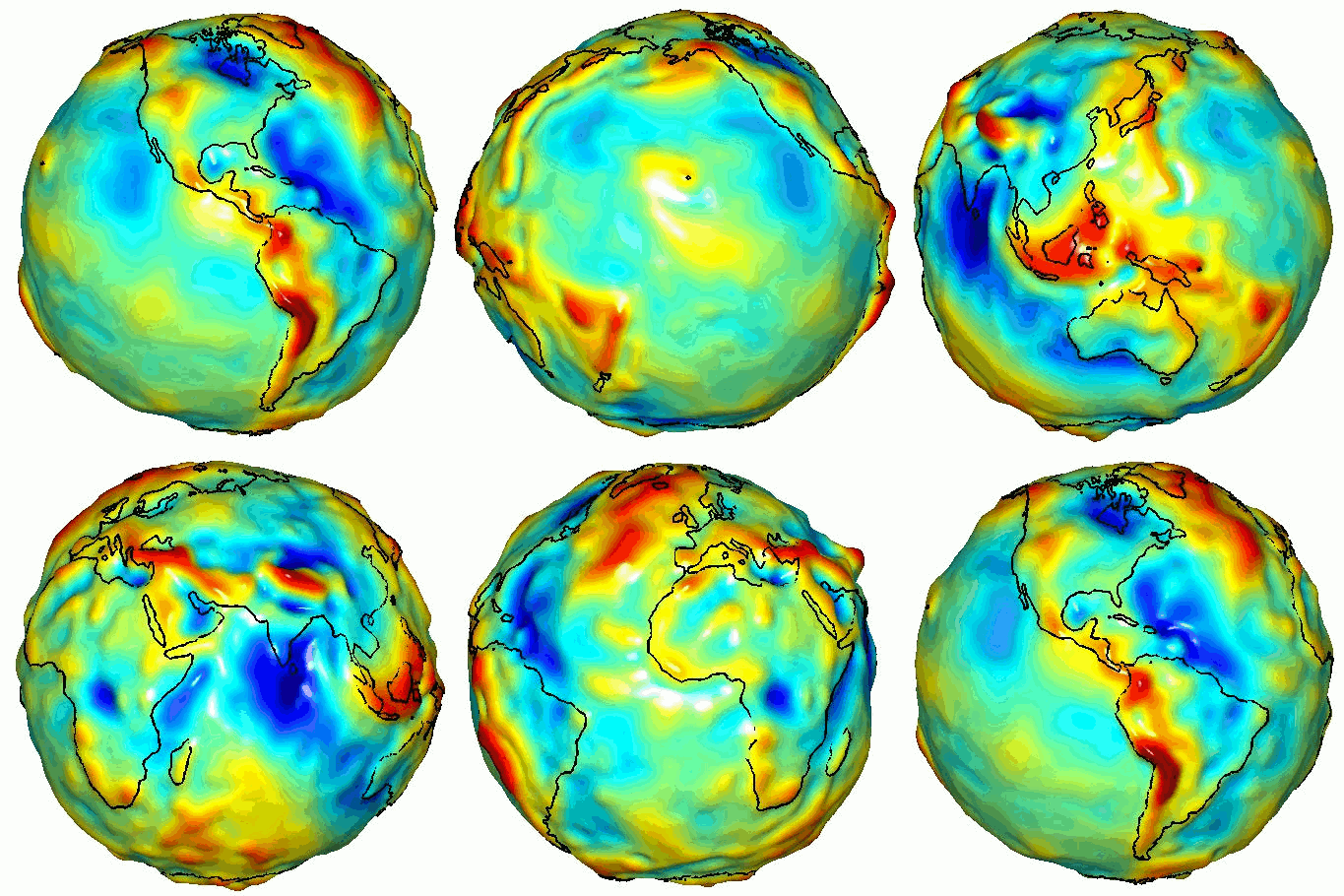

The inclination is along those 3 million square km, so nothing is noticeable, but it is measurable, there is 106 m compared to the average sea level on the planet, which is not regular, there are higher areas and others less as in But the deepest well is the one in the south of India.


The South Atlantic anomaly is magnetic, it is different, this is gravitational, it is gravity, here we are talking about gravity, not magnetism, not the Earth's magnetic field, the South Atlantic anomaly affects the Earth's magnetic field, that is, it affects that area, it is from the South Atlantic, but it fully affects all of Argentina, Chile, almost all of South America and it is an area where the Earth's magnetic field is more eroded, it is weaker, not much, that is, it is not something dangerous, but it is weaker and it is not known exactly why Nor is it another of the great mysteries, but in this case we are talking about gravity, gravity wells, places where the Earth's gravity is lower, there are two main ones, one in India, in the south of India, in the Indian Ocean, where the gravitational well is -106 m with respect to the average global sea level and the other would be in Antarctica, which is the one that has been studied now.


Souce


Can this anomaly evolve? It is the most surprising thing and it evolves very slowly over a period of millions of years, but the curious thing is that it moves and also changes intensity because until relatively recently until this study, now that I think about it, because in the case of the Indian which is most studied, they had not detected any type of evolution, that is, this is the first time that I have read in a study about a gravitational anomaly that has evolved, that has changed, that has changed its potency, its power.


Gravitational anomalies tell us that there is less or more density under that area, in the case of a gravitational well it means that there is less density. What is below is less dense and where there is more density, as you can see in the red areas they would be the areas of greater density, it means that under the Earth's crust there is more density, there is more mass, there are more metallic areas basically.


There is another anomaly called the Bangi anomaly under central Africa. It is a magnetic anomaly and the main hypothesis is that this anomaly is caused by a metallic core of an asteroid that impacted the Earth a long time ago and its core was left there stuck in the mantle of the earth and there it is, like a dense metallic mass that has not dissolved in the core, the Earth's mantle is what extends beneath the crust to the core.


In conclusion, the anomaly of Antarctica, which has been analyzed during its evolution during the last 70 million years, turns out to be not something static, it moves and also changes its intensity, it has changed its intensity by 30% in the last 35 million years with also previous fluctuations, it coincides with key climate changes such as the global cooling of the Legocene or Ligocene 34 million years ago and also when Antarctica went from being a continent of green meadows and forests to the block ice cream that we know today.


Study Source


The images without reference were created with AI
Thank you for visiting my blog. If you like posts about #science, #planet, #politics, #rights #crypto, #traveling and discovering secrets and beauties of the #universe, feel free to Follow me as these are the topics I write about the most. Have a wonderful day and stay on this great platform :) :)


! The truth will set us free and science is the one that is closest to the truth!


Posted Using INLEO


0
0
0.000
0 comments