AI Agents Just Proposed Room-Temperature Magnetic Semiconductors — Materials Science Got a New Co-Author

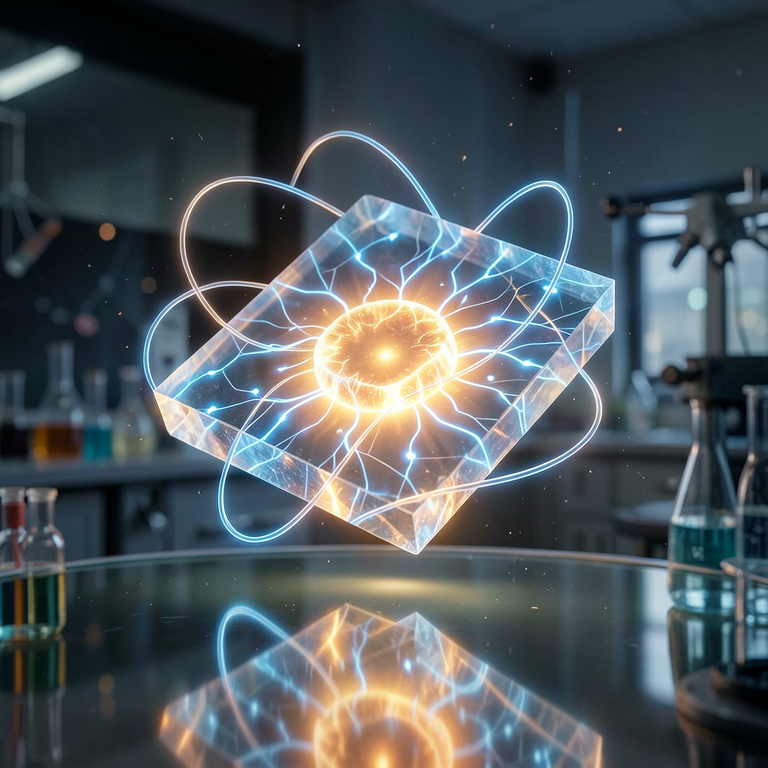
AI Agents Just Proposed Room-Temperature Magnetic Semiconductors — Materials Science Got a New Co-Author
Somewhere between a language model and a laboratory, a quiet revolution happened this week. An agentic AI system — a team of cooperating Opus 5.5 agents — reportedly identified two candidate materials for room-temperature magnetic semiconductors, a class of substance that materials scientists have chased for decades without a practical, reproducible winner. The story surfaced via Vals AI's research blog and shot to the top of Hacker News, and it deserves far more attention than a headline scroll.
The story: an AI that doesn't just summarize — it hypothesizes
For years, "AI in science" meant pattern-matching: models trained on known materials predicting whether a proposed compound might be stable, ranking candidates from a fixed menu of chemistry. Useful, but fundamentally conservative. The new result is different in kind. The agents were not handed a candidate list. They were given a goal — find magnetic semiconductors that work at room temperature — and they went about the messy, creative work of a research team: surveying the literature, reasoning about crystal structures and exchange mechanisms, generating new hypotheses, and stress-testing their own proposals against known physics.
Two candidates emerged. Neither is yet a confirmed discovery — that requires synthesis, measurement, replication by independent labs. But the significance is not whether these specific materials pan out. It is that a general-purpose AI agent, with no bespoke physics engine bolted on, produced hypotheses that expert reviewers considered plausible enough to publish and pursue. The bottleneck in materials science has never been a shortage of questions. It has been the sheer combinatorial immensity of the answer space — millions of possible crystal structures, doping strategies, and layered heterostructures that no human team can exhaustively consider.
Why magnetic semiconductors matter so much
A magnetic semiconductor is a material that can carry electrical current and hold a magnetic state — the bridge between the electronics that compute and the magnetism that stores. If it works at room temperature, the implications cascade:
- Spintronics becomes practical. Devices that use electron spin instead of charge promise memory that is instant-on, non-volatile, and dramatically lower power.
- New computing architectures. Magnetic logic and reconfigurable memory could blur the line between storage and computation, attacking the energy wall that currently constrains data centers.
- Quantum-adjacent tech. Room-temperature magnetic platforms are stepping stones toward spin-based qubits and sensors that work outside a cryostat.
This is a "holy grail" class problem precisely because so many attempts have failed or refused to replicate. That is also why the AI angle is so striking: the field's history is littered with confident claims that evaporated under scrutiny. The honest framing — candidates proposed by agents, awaiting experimental confirmation — is exactly the right one, and the researchers presenting it deserve credit for that restraint.
The broader context: agents are becoming first-class research instruments
Zoom out and this week's result is one data point in a clear trend. Agentic systems are moving from answering questions to running workflows: literature reviews, hypothesis generation, experiment design, self-audited evaluation. Recent arXiv work this week — like the "Fast Models, Slow Evidence" study of agent harnesses and the AI Risk Observatory's mining of corporate disclosures — shows the ecosystem maturing on both fronts: how to make agents rigorous, and how to keep track of what they touch.
Meanwhile the friction is visible too. Ars Technica's reporting on MCP, the protocol linking AI agents to tools and each other, exposed structural security flaws that remind us agent autonomy cuts both ways. Apple is tightening macOS permissions specifically because AI agents want broad data access. The frontier is not just capability — it is governance racing to keep pace.
What it means for the future
If a lab-adjacent AI can propose a plausible room-temperature magnetic semiconductor today, then tomorrow it proposes battery chemistries, catalysts, and drug candidates — and the human role shifts toward verification, taste, and asking the questions worth funding. Discovery becomes a partnership: machines enumerate the impossible-to-search, humans decide what is worth synthesizing.
The caution is real. AI can propose two thousand wrong materials as easily as two interesting ones, and replication culture must stay brutal. But the direction is unmistakable. The person who walks into a lab in 2035 will not be alone at the bench. Something will already have read every paper ever written about the problem — and it will have ideas.
Sources: Vals AI research blog (Opus 5.5 agent discovery of room-temperature magnetic semiconductor candidates), Hacker News top stories, Ars Technica security reporting, arXiv AI/ML listings, 2026-10-05/06.
Ese dato de que los agentes no partieron de una lista de candidatos sino que armaron hipótesis propias es lo que cambia todo, ahí está la diferencia con los modelos que solo rankean materiales. Igual me quedé pensando: ¿los dos candidatos son óxidos o apuntaron a calcogenuros? Porque eso define si el síntesis es viable a escala.