Electrifying Mysteries of Electric Eels

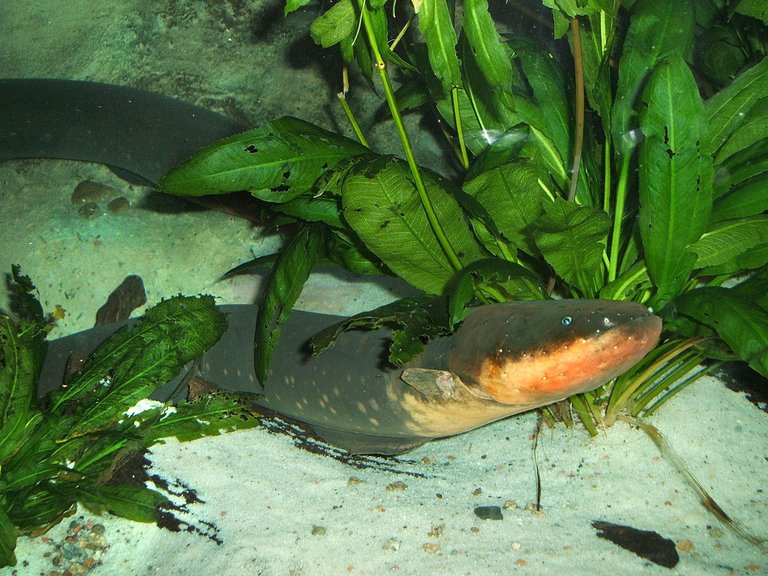
I was in Iwo, Osun State some days back to join a friend to explore the fascinating world of aquatic creatures. While I was already familiar with the Malapterurus electricus, this time our focus was on a different electrifying species, the Electrophorus electricus, commonly known as the electric eel. The two fishes are almost similar and I will be discussing the electric ell today.

Back in 1772, a captivating specimen of the electric eel was brought to Philadelphia from South America, captivating minds with its ability to deliver a shocking sensation akin to an electric shock. Unlike their name suggests, electric eels are not true eels; rather, they are members of the knife fish family and are more closely related to catfish. Among the various electric fish species, the electric eel stands out as a true electric powerhouse, capable of delivering shocks ranging from 600 to 800 volts, with the shocking effect lasting for several minutes.
Electric Eels live in streams, floodplains, and swamps but they are mostly found in the Orinoco and Amazon river basins. The fish can grow up to 8 feet in lenght and up to 40 pounds. The majority of the fishes body both by lenght and weight is dedicated to producing electricity. The habitat of this fish can be very disturbing as the water levels can reduce depending on the season but the fish has the ability to breath in water as well as breath air outside water. It is possible for the fish to breath air outside water as a result of a mucus membrane in the mouth that helps it absorb oxygen.
The Eel possesses 3 pairs of organs that are responsible for the production of its electric energy. These organs are the Sach's organ, the Hunter's organ, and the Main Organ which are made up of muscle cells known as electrocytes which are connected to the spinal neuron of the fish on one side. With the main and humter's organ producing high voltage that the Eel use in defending itself and stunning preys, while the Sach's organ is responsible for the production of low voltager which helps the fish to navigate and to communicate.

In the resting state of the fish, the electrocytes are negatively charged as a result of sodium and potasium ions being pumped out regularly but when the Eel is active or senses a prey or predator, the spinal neuron stimulates the gated channels of the electrocyte to open allowing for the flow of positively charged ions into its cells. The Eel discharges the electric charge through its head where it is discharged towards the prey. On one side of the Eel which is connected to the spinal neuron, electric charges go in, while on the other side, it goes out creating a dipole. This form of charge was what inspired the creation of the battery in the 1800s by Alessandro Volta.
Despite their remarkable electric abilities, electric eels have relatively poor eyesight. However, they compensate for this with their adept use of weak electric charges to navigate their surroundings. By detecting distortions caused by objects that conduct or repel their electric charge, electric eels can gain a clear understanding of their environment. These creatures are primarily nocturnal hunters, utilizing darkness to their advantage when seeking out prey.
But how do electric eels prevent themselves from getting shocked by their fellow eels in the water? Interestingly, electric eels possess adipose tissues that insulate them from their own electric charges. While this insulation prevents self-electrocution, it doesn't shield them from shocks delivered by other electric eels. However, due to their size, the shocks from other eels are generally not strong enough to cause harm or electrocution.
Intriguing and remarkable, electric eels stand as a testament to nature's ingenuity, showcasing how creatures have evolved to wield electricity for various purposes in their underwater world.
Reference.
- https://academic.oup.com/book/2827/chapter-abstract/143397166?redirectedFrom=fulltext
- https://www.jstor.org/stable/25650627
- https://study.com/learn/lesson/electric-eel-voltage-facts-habitat.html
- https://www.nationalgeographic.com/animals/fish/facts/electric-eel
- https://aqua.org/explore/animals/electric-eel
- https://www.chm.bris.ac.uk/webprojects2001/riis/electriceel3.htm
- https://www.sparkmuseum.org/voltas-fishy-invention/
- https://www.scientificamerican.com/article/how-do-electric-eels-gene/
Nice one @futurekr
Short and crisp knowledge about electric eels. I wonder how many of them is required to neutralise an adult human being.
Any comments
I cannot really say about that because I do not have access to try that personally but 600 to 800 volts isn't little. A 40-watt DC lightbulb needs around 120 Volts. It will require a number of electric ell working together to deliver such volts.
Just in case it didn't kill you, you might have the privilege to become Electro.
Thanks for your contribution to the STEMsocial community. Feel free to join us on discord to get to know the rest of us!
Please consider delegating to the @stemsocial account (85% of the curation rewards are returned).
Thanks for including @stemsocial as a beneficiary, which gives you stronger support.