RE: Bots Represent 64% Of Internet Traffic

You are viewing a single comment's thread:
yeah... its a bit hard to technically explain to the general public what a bot can be right? And also how to limit the definition of a bot by itself... for that matter, any DNS resolution could be a bot just for that matter.
I am exaggerating but you get the idea.
0
0
0.000
I suspect that it is even harder explaining the concept to a technologist.
When I examine web logs, I try to figure out which hits are from bots and which are from users. I will often find a group of computers hitting my servers with hundreds of thousands of requests.
That's why I said 64% might be low.
Here on HIVE we can look at HiveBlocks.com or he.dtools.dev
After I read your post, I looked that transactions in my account and realized that most of them come from bots. Since this is your post, I will link to your accounts.
https://hiveblocks.com/@forykw
and
https://he.dtools.dev/@forykw
When we write posts and upvote, the activities clearly start with humans.
For each posts and update, there are multiple curation rewards.
The curation rewards come seven days after publishing a post. In this report, would one classify the curation rewards as a bot?
No... in this case the act of receiving the reward no... at least. Because that is already programmed to happen since its essence (on HIVE code), but eventually, you will have to claim for it to become liquid/staked, and that one witch is from itself another transaction, it can be either human or done by a bot that has authority to use your posting key.
The vote that the bot does (aka broadcast), is another one.
So, yeah... I see why you said that, but I was just trying to put myself in Scott shoes and try to define the limit of the "bot" to explain to masses... which majority of them might not even understand what I just explained above.
I can provide you with examples if this is not clear.
Since HIVE is transparent we can see all of the transactions. We can also see how difficult it can be to cleanly separate the transactions that result from human activity and those that are purely programmatic.
This problem appears in a number of real world scenarios. For example, some companies tried selling advertising based on click traffic. Scammers quickly became adept at flooding CPC campaigns with fake clicks. The same happens with CPM marketing as the scammers know how to flood ad campaigns with fake page views.
In that context, that problem quickly gets sorted/reduced in HIVE by the fact of anyone being able who is authorized to use your keys.
For example, I am trusting these to handle my posting key functions on my behalf.
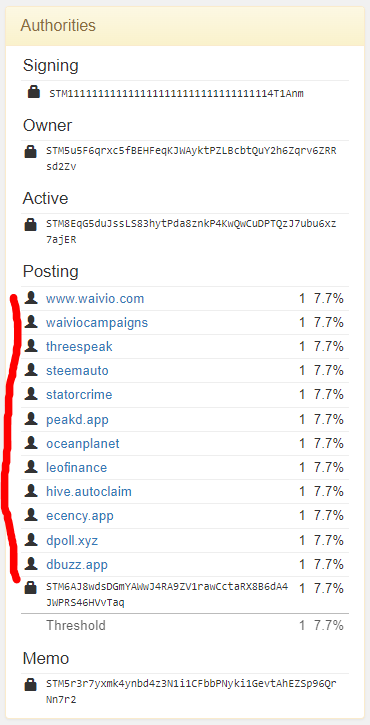
If there are no authorizations, then it means either the owner of the keys given them to someone else, foolishly breaking its security on their own, or it's savvy enough to create its own scripts in secure places where no other entities have access to the keys.
So yeah, without a proper security methodology adopter of ownership and authority delegation transparently visible, it's very hard to separate those scenarios. But when specific authorization is visible (case of HIVE), contrary to other social media, it becomes easier to investigate or estimate what is a "robot" or "human" interaction. This is why HIVE will eventually show the world, how much this technology will revolutionize social interaction and censorship control/absence.