The Mute Swan, Beautiful and "Prohibited" in New York
My daughter goes to the beach just about any day a thunderstorm doesn't prevent that recreation. Rain is not a disincentive, as long as there are no booming clouds overhead. A couple of weeks ago she told me, after one of her beach expeditions, "The swans are back. Now they have babies!"
I was surprised that this was the first year she had seen babies with the long-established swan pair. Now I understand why. These birds are not welcome in New York State, and there is a program afoot to prevent eggs from hatching. As a matter of fact measures are also in place to make the swans sterile.
Here is a picture she shot of the swan family that day. You can see they came very close to shore.

These are mute swans, Cygnus olor, and they are considered an invasive species in the U.S. The birds were introduced into the country as decorative pets in the late 1800s. As is often the case, a few escaped into the wild, and the rest, as they say, is history.
Originally the birds established themselves as ferals in New York and New Jersey. Now the population has spread. According to the Cornell Lab they are "now established in the Northeast, Midatlantic, Great Lakes, and Pacific Northwest of the U.S."
Here is a close-up picture of the swan I found on Wikimedia Commons.
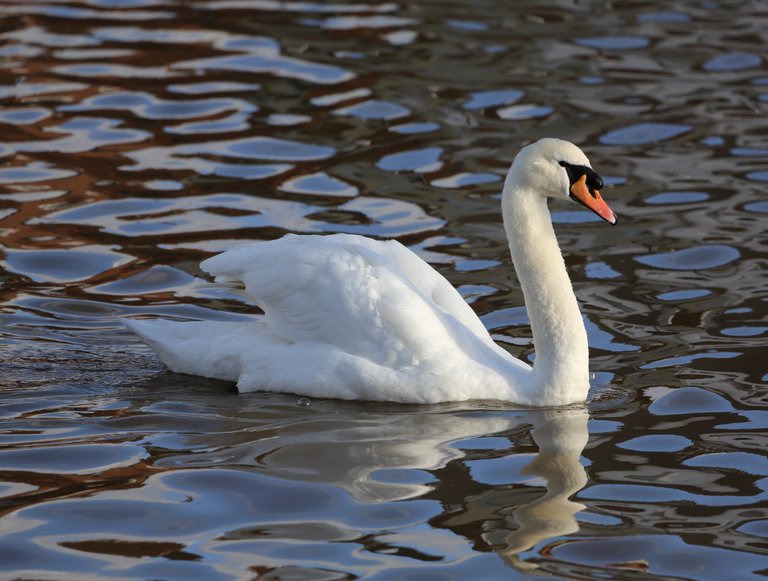 Credit: user, Geni. GFDL CC-BY-SA

The birds are easily identifiable by the black splotch on the face and by the black bulbous protrusion over the beak.
Back in 2014 New York was planning to launch a population control program that included killing or capturing all 2,000 of the swans that were known to exist in the state at that time. The plan was to wipe out the population by 2025. There was public outcry, and since then the more benign program to addle (by oiling them) eggs and sterilize adults was put in place.
California mute swans are not so lucky. There it is literally open season on mute swans and hunters are encouraged to go at it.
Here is a picture my daughter shot of the family drifting in Oyster Bay Harbor, which is a relatively protected body of water.

Apparently the swans are not welcome by the state not only because they eat native vegetation, but also because they physically chase off native bird species. Besides chasing off other species, the swans consume food that otherwise would feed a native species. Most of the plant life the swans consume is under water. This seems to be particularly damaging to the local ecosystem.

You can see there are three babies. Baby swans are called cygnets and are tended by their parents for months, until they are grown. The mother does most of the tending. The father serves as guardian of the family. Male swans can be quite ferocious in their capacity as guardian. This is one of the reasons they are not considered to be good neighbors.
A paternal male swan will attack a human, if the swan feels threatened, and it will kill small pets and birds. Hard to believe when they look so graceful and lovely, isn't it?
Here is a rather blurry video my daughter shot of the swans floating in the bay. You can see the father is keeping his eye on my daughter and her dog.
In this picture you can see the father in his customary vigilant pose, and the mother seems to be diving under water. While swans are essentially herbivores, those who swim in the bay will also eat insects and mollusks. Perhaps the mother was opportunistically diving for one of these creatures that happened to be passing by.

Here we see the parents swimming like bookends, one on each side of their brood. The brood swims safely between them. It's hard to see anything menacing about these beautiful creatures, with their devoted parenting habits. However, apparently looks can be deceiving. Notice you don't see other birds around the swans, and this bay is usually teaming with seagulls and water fowl.

My daughter's dog was fixated on the swans. You can see him in this picture, head down and staring. The birds seem to know he is not a threat to them.

Here he is again, mouth agape, studying the swans. I don't think the dog would bite them if he had a chance. He does like to chase things, though. In this picture you can see one of the young swans reaching its full height, craning its neck to look at something.

Here we can see both swans taking note of the dog and my daughter. She said the swans did tolerate their presence well until a noisy women arrived. The part of the beach where my daughter chose to put her blanket was isolated. All the people were at the other end of the shore.
When the noisy woman arrived she stood right behind my daughter and spoke loudly. She disturbed not only my daughter, but put the swans on high alert. It was only at that point that the father approached and made threatening gestures to my daughter, the dog and the woman.
My daughter got up and walked off to another quiet part of the beach.

Here is the dog intent on his swan observation. The birds seem to be separating. The cygnets are going with the mother and the father is keeping a watchful eye.

New York does have indigenous swan species...two of them: the trumpeter swan and the tundra swan.
Here is a picture of two trumpeter swans (Cygnus buccinator), from Wikimedia Commons:
 Credit: Andy Reago & Chrissy McClarren CC 2.0
Trumpeter swans were once almost extinct, but through conservation efforts the population has rebounded.
.jpg)
Here is a picture of a tundra swan (Cygnus columbianus), also from Wikimedia Commons

Credit:Dominic Sherony. CC 2.0
Tundra swans breed in the arctic and may only be seen in New York during winter. This was a swan that was identified by Lewis and Clark on their cross-continent expedition. They called the swan the "whistling swan".
_(8571142484).jpg)
I'll end this swan excursion with a final picture of my daughter's dog and the swan family floating peacefully in the distance.

Thank you for reading my blog. Peace and health...Hive on!
Oh yes, swans are very territorial, they even hiss at humans if you get too close to them, not just if you harm them... They are a sort of aggressive goose just with less noise
But they are beautiful
According to the experts, mute swans are especially aggressive--especially when they have babies.
I love them :)
I had no idea these swans were considered an invasive species! We have small numbers of them landing in the ponds in the wetlands around us during the spring migration. I think they have their babies elsewhere though because I've never seen little ones around.
Well they sure don't like them in California. I'm proud of my neighbors on Long Island for putting a stop to the killing.
By the way:
Every now and then I Google my name. I want to see if I have become completely invisible :) I received a surprise. One of my books, one that never sold a copy as far as I can tell (except the ones I bought😄) has ended up in the Smithsonian Libraries and Archives.
https://www.si.edu/object/four-masters-yuan-and-literati-art-tradition-china-mongol-rule-modern-times-g-moore%3Asiris_sil_1167806
This doesn't mean anything to anyone but me. However, I think as a fellow author you can appreciate that I am tickled. I was always proud of that book and knew it would probably never find an audience (especially since it has color illustrations and is therefore expensive). As an old lady, I get great satisfaction knowing that at least with one person out there (whoever does the curating for the libraries) my book made the cut.
The Smithsonian!! That’s amazing @agmoore! I had no idea you had a book published. I understand totally! When I travel I always leave a copy or two of mine in Airbnbs or donate them to local libraries. It makes me happy to know there are copies scattered across the world and strangers might be picking them up and reading in the quiet of the morning as they’re having their coffee.
Thank you!
I went through a book writing phase. Self-published my first book in 2011 and my last in 2017. It was as though I had a fever :) It started with a book about my experience with an illness that defied diagnosis for years. That book was featured as a small blurb in a foundation magazine. With the boost it took off in that small community. After the first highly focused book, I pumped out a bunch of educational books, mostly history. Then a vampire book :) Then a memoir :)). Then, finally the last book on Chinese art and history. The last was my best, without a doubt. When I finished writing that book I asked one of the featured artists' descendants for feedback and information. He offered to sponsor an opening in Malaysia. Of course, I can't go to Malaysia. And that was the end of it. I kept a few websites going, did some book reviewing, and then came to Hive. That's my writing history. Didn't really amount to anything at all (except the first book, which people still read but I do give it away free as an ebook). Yes, I had the author bug and now I'm at peace.
I just had to share the Smithsonian news with a few people who might understand that it was validation. Nice to have as the sun sets :)))
You're welcome! That really is a huge accomplishment that you should be proud of. I thought I had it all out of my system too until just recently. It's just such an inner struggle to learn to accept the fact that mainstream commercial success isn't what defines your writing career—it's getting to do what you love. If you can make a living at it, even a meager one, then that's the icing on the cake.
Yes. The secret to a happy life🌟
(I just upvoted my own comment!)
!discovery
Thank you very much, @esther-emmanuel!
This post was shared and voted inside the discord by the curators team of discovery-it
Join our Community and follow our Curation Trail
Discovery-it is also a Witness, vote for us here
Delegate to us for passive income. Check our 80% fee-back Program
Your support is very much appreciated!🌟
Always stay away from swans :-D Between the dog and the swan, it's maybe 50/50. Swans are incredibly powerful, sharp teeth, strong wings that can break arms. At least that's what I was always told. And they're moody. Not as bad as Canadian Geese, but not far behind.
Incredibly graceful creatures. And fascinating in their behavior. It's a shame for the individual swans that they're invading, but the native swans are definitely worth to preserve, too, so it's bad luck for the mutes.
Great post, thank you for sharing!
My daughter wasn't going to bother those swans. She knows they are dangerous. The dog was on two leashes, attached to her ;)
Only when that noisy woman came did the swans become alarmed. My daughter left.
Invasive, native...everybody who lives in the U.S. is technically invasive:))We all came from somewhere, or at least our ancestors did. I guess the ecologists know what they are doing, but I draw the line at killing the animals. Any other measures are OK with me.
Thanks for the great comment!
Support engagement with a delegation to topcomment:
50HP - 100HP - 250HP - 500HP - 750HP - 1000HP - 1500HP
What ever happened to the survival of the fittest? We should leave the bloody swans alone to do their thing. It seems to me that every attempt we make to control nature just makes things worse. I love swans:)
Non-native lionfish in Florida are an absolute menace on the reefs, and have no predators other than humans. It's a real problem with many species around the world. They do real damage to the native ecosystem. They aren't winning because they are the fittest, but because nothing has a chance to adapt to an environmental shock before the damage is too much to recover.
I stand corrected:)
How about those pythons in the Everglades? Humans messed up the environment by introducing these giant, predatory snakes. I guess it's only right that humans interfere to try to reset the balance. Good luck with that!
And then there's the Everglades themselves, where humans decided nature needed to be "fixed," and also purely by coincidence, "reclaim" land for the sugar cane industry in agriculture. Big government spending destroyed the environment.
I thought of Marius the giraffe as I wrote this. Ecologists are not necessarily lovers of nature. They are calculating scientists. They don't see the swan's feathers, they don't see Marius' lovely eyes. They see numbers. Might as well be accountants.
I do understand land management, trying to pull the humane levers that help to restore balance. But murder??? no.
That's humanity for you. When it comes to animals, we're anything but humane.
It's easier to get people to support eradicating an invasive species if it's an ugly bird or nuisance insect, less so when it's an elegant bird.
I think part of the problem is, to the uninitiated, they are all swans. Trumpeter, tundra, mute. Ecologists make distinctions based on small differences between species. That's what it seems like to us, those of us who just love to look at the animals. However, I did find this passage:
Humane population control seems to be reasonable. If we understand that the habits of this bird will truly upset the balance in our environment, we can get behind humane efforts to control the population.
Congratulations @agmoore! You have completed the following achievement on the Hive blockchain And have been rewarded with New badge(s)
Your next target is to reach 20000 replies.
You can view your badges on your board and compare yourself to others in the Ranking
If you no longer want to receive notifications, reply to this comment with the word
STOPI really enjoyed reading this. I always thought swans were peaceful and harmless because they look so graceful, so I was surprised to learn that mute swans are considered an invasive species in New York. It was interesting to read both sides of the story. The photos of the swan family and the cygnets were beautiful, and it was nice that your daughter was able to observe them from a respectful distance. Thank you for sharing something that was both enjoyable and educational.
Thank you! I was also surprised to find that swan species was invasive. I did notice that in the pictures no other birds were nearby. Usually, when we go to that beach, we'll see geese, ducks and seagulls mixing together. I guess none of those birds want to go near the aggressive swans :)
Dear @agmoore !
Madame!
I was surprised to learn that white swans on the U.S. East Coast are destroying the ecosystem!
I thought that such a problem arose because people brought white swans from Europe to the United States!
I support the policy of controlling the white swan population to protect the natural environment of the United States!